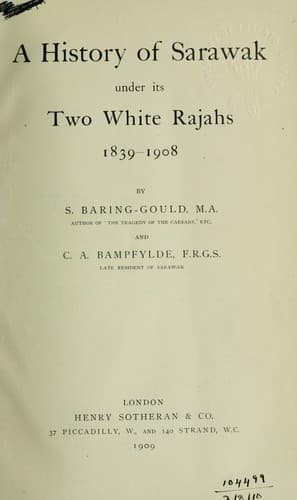
A History of Sarawak under Its Two White Rajahs 1839-1908Baring-Gould, S. (Sabine)
History
A History of Sarawak under Its Two White Rajahs 1839-1908
Baring-Gould, S. (Sabine)
Charles, Rajah of Sarawak, 1829-1917; James, Rajah of Sarawak, 1803-1868; Sarawak (Malaysia) -- History
Previously to the appointment of a British Resident at Bruni, the Rajah
had, as we have noticed, administered the government in the Muara
district, with the full approval of the Sultan. In compliance with the
Rajah's desire, the Sultan had placed a Malay chief, as his
representative, at Brooketon, but even his salary had to be paid by the
Rajah. It has already been shown that certain judicial powers have been
vested in the Rajah under the revenue concession, in regard to which the
then British Consul at Bruni had occasion to write to the Rajah's agent
at Labuan in July, 1900, that "the acting High Commissioner for Borneo
believes in and acknowledges the right of Sarawak to exercise
magisterial powers in Brooketon." Nevertheless, on the appointment of
the British Resident at Bruni the Colonial Office called upon the Rajah
to withdraw his officials and police from Brooketon, and notified him
that the administration of the district would be carried on by the
Resident, in the Sultan's name. In a written reply to a question by Sir
Edward Sassoon, the Under-Secretary for the Colonies denied that by the
deed the Rajah was authorised to maintain a police force in Bruni
(_sic_), but passed over in silence the main point of Sir Edward's
question as to the Rajah's powers to adjudicate as well as to impose
fines throughout the district of Muara.
In a leading article which appeared in the issue of the _Straits Budget_
(Singapore) of January 10, 1907, the editor attempts to refute the
issues raised in the questions put by Sir Edward Sassoon in the House of
Commons, and the arguments advanced in an editorial article which
appeared in the _Standard_ dealing with the above matters. He writes
authoritatively in reply to Sir Edward and "the special pleading" of the
_Standard_, and presumably his article is therefore an inspired one, for
his own knowledge of Bornean affairs is restricted to what "the man in
the street" can tell him, and his leader displays a deeper insight into
the political aspect than can usually be found outside of a Government
office. He tells us that: "Bruni wanted better administration. There
were three possible ways of obtaining this—the Protectorate might have
been transferred to the British North Borneo Company; it might have been
handed over to the neighbouring Rajah of Sarawak; or it might have been
incorporated in the territories administered by the Colonial Office
through the Straits Settlements. Of the three alternatives the Foreign
Office chose the last. No doubt Sarawak is an object lesson in
administration, but it must not be forgotten that it has been fortunate
in having two successive rulers of marked capacity for dealing with
native races. It may not always be so fortunate, and perhaps the Foreign
Office, having this possibility in view, hesitated to add to the
territory of Sarawak. On the other hand, the experience of the Federated
Malay States and the Straits Settlements warranted the handing over of
Public-domain text, read in full here on John Shaqi.
Reviews
Reviews
No reviews yet
Be the first to share your thoughts on this work.
Elsewhere in the archive
Join the Discussion
Join the discussion
Sign in to leave a comment or review.
Sign InorCreate an account