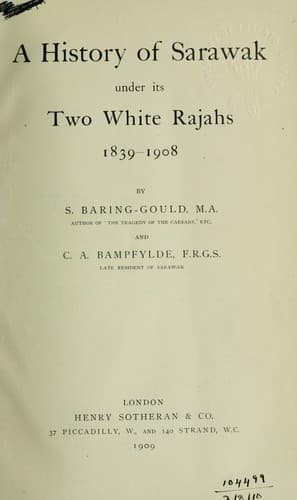
A History of Sarawak under Its Two White Rajahs 1839-1908Baring-Gould, S. (Sabine)
History
A History of Sarawak under Its Two White Rajahs 1839-1908
Baring-Gould, S. (Sabine)
Charles, Rajah of Sarawak, 1829-1917; James, Rajah of Sarawak, 1803-1868; Sarawak (Malaysia) -- History
The Ulu Ai[327] Dayaks, or, as the name implies, those inhabiting the
head-waters of the Kapuas, Rejang, and Batang Lupar, are nowadays the
sole offenders, and although they lead others astray, these troubles
involve but a small proportion of the Dayak population, but five per
cent, or one per cent of the entire population of Sarawak.
A quarter of a century ago, Malays were forced to live together in
villages, for their protection against the Sea-Dayaks, and were
constrained to move in strong and well-armed parties when visiting these
people for the purpose of trade. Now they occupy scattered houses on
their farms, where they can make gardens and plantations, and they mix
freely with the Dayaks without the least fear.
But even the Ulu Ai Dayaks, in spite of their occasional lapses, are far
from being inimical to the Government, for which they are ever ready to
work, and which they will as readily follow. At all times, its officers,
English and Malay, are quite safe amongst them, and are received with
respect and cordiality. Punishments, however severe, are submitted to,
and do not affect their feelings towards the Government. On the whole
these Ulu Ai Dayaks are well disposed, but they allow themselves to be
led astray by the more unruly and restless spirits in the tribes; yet
even of these latter, some have been brought to become staunch
supporters of the Government.
The Saribas Dayaks, formerly the most malignant and dreaded of pirates
and head-hunters, and the bitterest opponents of the Rajah, have long
since become the most peaceful subjects of the State, and have developed
into keen traders and collectors of jungle produce.
The Sekrangs, with the exception of one outbreak, noted on page 381, for
which a treacherous Government chief was solely responsible, have been
as peaceable and law-abiding as the Saribas. These, with the Undups and
Balaus, ever the faithful friends of the Government and the bravest—"a
more plucky and sterling set of bull-dogs there is not to be found," the
Rajah wrote of the former many years ago—are now the best-disposed
people in the State. With them perhaps may be included the Lemanaks, and
the Engkaris, who, however, have not gained for themselves the same
character for straightforwardness. The Ulu Ai are alone the
peace-breakers. Physically these men are the finest of all, but are
coarser in manners and not so brave. All these tribes, with the
exception of the Undups and Balaus, having greatly multiplied, have
spread over Sarawak, and become much mingled.
[Illustration:
THE SARAWAK RANGERS.
With the exception of the Band (Philippines and Malays) and three
Sergeants, the men shown here are all Sea-Dayaks. The battalion is
composed of some 275 Sea-Dayaks, 100 Sepoys, 50 Malays, 25 Javanese,
and 20 Philippine bandsmen, under an English Commandant and an
Instructor (shown). The force was established in 1846 under a native
officer of the Ceylon Rifles.]
Public-domain text, read in full here on John Shaqi.
Reviews
Reviews
No reviews yet
Be the first to share your thoughts on this work.
Elsewhere in the archive
Join the Discussion
Join the discussion
Sign in to leave a comment or review.
Sign InorCreate an account