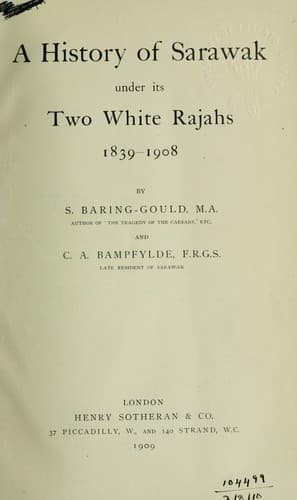
A History of Sarawak under Its Two White Rajahs 1839-1908Baring-Gould, S. (Sabine)
History
A History of Sarawak under Its Two White Rajahs 1839-1908
Baring-Gould, S. (Sabine)
Charles, Rajah of Sarawak, 1829-1917; James, Rajah of Sarawak, 1803-1868; Sarawak (Malaysia) -- History
Besides being very intelligent, the Sea-Dayaks are wonderfully energetic
and hard-working. They are thrifty, eager to become well-off, are
honest, and have few vices; but they lack channels for their energy.
Regular employment in their own country by the establishment of
industries, such as plantations and mines, would do more for their
redemption from savagery than years of labour among them by officials
and missionaries. At present, their energies are almost entirely
confined to working jungle-produce; though to seek this, they have now
to go into the far interior, and this is often the cause of their
getting into trouble with remote and wild tribes; they go also to North
Borneo, Dutch Borneo, Sumatra, the Malay peninsula, and even as far as
Mindanau, in the Philippines. These countries they visit in large
numbers, and abroad their honesty and energy have gained them a good
character. Many Dayaks place the money they have saved with the Chinese
on interest; some have erected shops, which they let for rent; but with
most the prevailing idea of riches is an accumulation of old jars and
brassware. There is no man keener on the dollar than the Dayak, or
keener upon retaining it when gained; and there is no better labourer,
but the employer of Dayak labour must be tactful and just. As they
become more prosperous they discover for themselves that it is more
conducive to their welfare not only to be on good terms with the
Government, but at peace with their neighbours.
[Illustration:
SARAWAK RANGERS IN MUFTI.]
The Dutch in the Kapuas have experienced considerable difficulty in
dealing with the many tribes of different races, especially with the
Sea-Dayaks, who inhabit that vast river, which runs past the heads of
the Batang Lupar and the principal left-hand branches of the Rejang
river, but they have made some advance in the pacification of these
people, though their methods are very different, far less energetic and
much slower, than those of the Rajah.
The highlands, the spine of Borneo, along which runs the frontier, is no
mountain ridge, but a broken upland district, that forms the watershed
of the great rivers of Sarawak on one side, and the still greater rivers
of Dutch Borneo on the other. It is a region difficult of access from
the coast on both sides, and long after the Dayaks living lower down had
become peaceful, turbulence and internecine warfare remained chronic in
the interior. And this was the more difficult to suppress because the
aggressors had but to step across the boundary, where they could not be
pursued by the forces of the Rajah. This was perfectly well understood
by these savages, and was taken advantage of repeatedly, and the efforts
of the Rajah were in consequence continually thwarted.
Public-domain text, read in full here on John Shaqi.
Reviews
Reviews
No reviews yet
Be the first to share your thoughts on this work.
Elsewhere in the archive
Join the Discussion
Join the discussion
Sign in to leave a comment or review.
Sign InorCreate an account