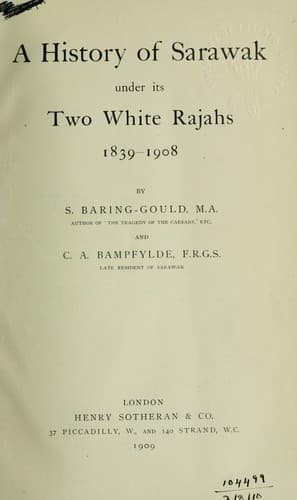
A History of Sarawak under Its Two White Rajahs 1839-1908Baring-Gould, S. (Sabine)
History
A History of Sarawak under Its Two White Rajahs 1839-1908
Baring-Gould, S. (Sabine)
Charles, Rajah of Sarawak, 1829-1917; James, Rajah of Sarawak, 1803-1868; Sarawak (Malaysia) -- History
The following year the Batu Bangkai Dayaks of the Kapuas, in conjunction
with some Katibas Dayaks, made a determined attack on the Lemanak
Dayaks. The Lemanak is a confluent of the upper waters of the Batang
Lupar. The repeated outbreaks of these turbulent natives was entirely
due to their proximity to the Dutch frontier, and to their knowledge
that they had but to step across the border to escape the Government
forces; and at that time the Netherlands Government insisted upon the
border rights being strictly respected; moreover their troops, the only
forces they had at their disposal, were totally useless in acting
against Dayaks, who can only be tracked by fellow Dayaks. The
Netherlands officials in the Kapuas were themselves aware of their
inability, and were averse to the policy of their Government. Powerless
themselves, unwilling or unable to use Dayak auxiliaries, they were well
content to let the Rajah do the work for them which they could not do
themselves. But the central Government objected.
The Ulu Ai Dayaks of the upper Rejang, after having been peaceable for
many years, were encouraged by these circumstances to break out again,
and even those who were disposed for peace were terrorised into joining
in these forays by a threat of having their houses burnt down over their
heads, unless they came out upon the war-path.
In October, 1875, the Rajah led a large force against the upper Batang
Lupar Dayaks, who had been giving great trouble, and forty of their
villages were destroyed; but deeming this punishment inadequate, the
attack was followed up by another delivered two months later; the
rebels, completely surprised, suffered severely, and hastened to tender
their submission.
[Illustration:
KAPIT FORT—REJANG RIVER.]
The turn of the Katibas was to follow shortly. The Kapuas Dayaks over
the border were still unchecked, and knowing how incapable the Dutch
officials were to subdue them, and secure as they believed themselves to
be behind the frontier, they became insolent, and in February collected
a large force of over 2000 fighting men to punish the Dayaks up the
Batang Lupar for having submitted to the Rajah. They came within two
hours' march of Lobok Antu fort, but here they found the Resident of the
district at the head of a large force blocking their way. The Dutch
Controleur in vain endeavoured to persuade these Dayaks to disperse and
return to their homes; and they had the insolence to send the Resident
an intimation that they would do so if he paid them a fine of eight old
jars, and declared that if this were refused, they would attack Lobok
Antu in force. As the Resident could not cross the border to punish
them, this was just what he wanted them to do, and he was perfectly
prepared to give them a hot reception. But they changed their minds and
withdrew, leaving him greatly disappointed that he had not been able to
administer to them a much-needed chastisement.
Public-domain text, read in full here on John Shaqi.
Reviews
Reviews
No reviews yet
Be the first to share your thoughts on this work.
Elsewhere in the archive
Join the Discussion
Join the discussion
Sign in to leave a comment or review.
Sign InorCreate an account