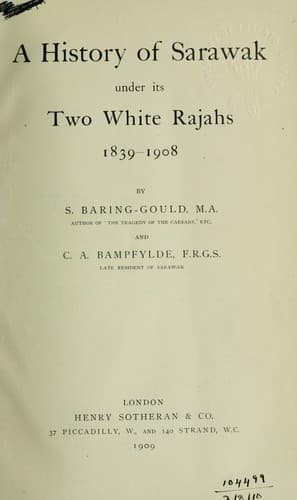
A History of Sarawak under Its Two White Rajahs 1839-1908Baring-Gould, S. (Sabine)
History
A History of Sarawak under Its Two White Rajahs 1839-1908
Baring-Gould, S. (Sabine)
Charles, Rajah of Sarawak, 1829-1917; James, Rajah of Sarawak, 1803-1868; Sarawak (Malaysia) -- History
A series of expeditions was planned by his Highness that for this reason
met with but partial success. It is unnecessary to record the details of
each, for each repeated the experience of the former with painful
iteration, and we have already given an account of some of the earliest
of these punitive expeditions. But it will be necessary to record them,
to show how great were the difficulties the Government had to contend
with before the turbulent tribes of the interior could be brought to
submission.
A great many of the Ulu Ai Dayaks had settled in the Katibas river,
which is the highway from the Rejang to the Kapuas river in Dutch
territory, and these Dayaks were incessantly giving trouble by making
predatory raids against their enemies over the border.
The Dutch had complained of this, and the Rajah had attacked them in
1870, as we have recorded, but as they continued to give trouble, he
again attacked them, for the third time, in July 1871, taking them on
this occasion completely by surprise; and driving their chief, Unjup,
over the frontier, where he might have been captured. Unjup was the
brother of the powerful chief Balang, who had been previously executed
for plotting against the Government.[328] Later on he was allowed to
return, and was pardoned on making humble submission. He subsequently
became a Government chief or pengulu, but he was a useless character.
After the third attack, this tribe was moved to the lower waters of the
Katibas, and an interval of uninhabited jungle was put between them and
their enemies.
However, what is born in the bone must come out in the flesh, and, in
1874, they again broke away and attacked, on this occasion the Tamans
and Bunut Malays of the Kapuas. It was, however, a case of _lex
talionis_; and these people had brought it upon themselves by their own
treacherous conduct in inveigling six Dayaks, who were on a peaceful
visit to their country, into a Taman house, where they were seized and
bound. Thence these six had been sent to Bunut, a large Malay
settlement, and were there put to death in a most cold-blooded manner.
Nevertheless the Dayaks had to be taught not to take the law into their
own hands. But properly the Netherlands officials were the most
blameworthy for not having promptly secured and punished the Malay
murderers and their accomplices.
Public-domain text, read in full here on John Shaqi.
Reviews
Reviews
No reviews yet
Be the first to share your thoughts on this work.
Elsewhere in the archive
Join the Discussion
Join the discussion
Sign in to leave a comment or review.
Sign InorCreate an account