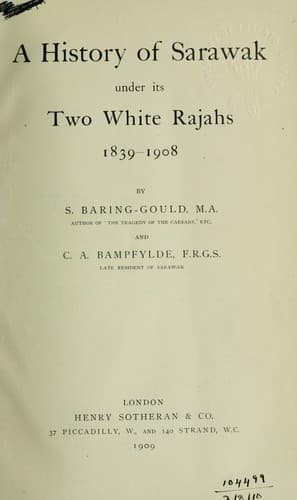
A History of Sarawak under Its Two White Rajahs 1839-1908Baring-Gould, S. (Sabine)
History
A History of Sarawak under Its Two White Rajahs 1839-1908
Baring-Gould, S. (Sabine)
Charles, Rajah of Sarawak, 1829-1917; James, Rajah of Sarawak, 1803-1868; Sarawak (Malaysia) -- History
"I admit that Bruni has its points, but what irony to compare for a
moment the city of marble palaces with the mass of miserable huts
which a single match could easily reduce to ashes."—Beccari, _op.
cit._ The Rajah called the place a "Venice of hovels." Mercator in his
Atlas describes it as "being situated on a saltwater lagoon like
Venice," hence probably it became known as the Venice of Borneo.
Footnote 102:
_Kota batu_, stone fort. The name still remains. It was built towards
the close of the fifteenth century by Sherip Ali, the first Arab
Sultan, with the aid of the Chinese subjects his wife's mother had
brought to Bruni. The city was then nearer the mouth of the river. It
was moved to its present position by Sultan Muadin about 200 years
ago.
Footnote 103:
Magellan, _Hakluyt Society_, and the Portuguese Jorge de Menezes, who
visited Bruni five years after Pigafetta, notices that the city was
surrounded with a wall of brick, and possessed some noble edifices.
Other early voyagers describe the sultans and rulers of Malayan States
as maintaining great style, and their equipments,—such as swords of
state, saddles, chairs, eating and drinking utensils—as being of pure
gold. Allowing for some exaggeration, this would still point to a
former condition of prosperity which enabled rulers and nobles to keep
up a pageantry which has long since vanished.
Footnote 104:
This malformation, according to the laws of Bruni, would have
disqualified him for the throne, for these provide that no person in
any way imbecile in mind or deformed in person can enjoy the regal
dignity, whatever title to it his birth might have given him.—Sir Hugh
Low, _op. cit._ p. 108.
Footnote 105:
_Saya_, or more correctly, _sahaya_ (mis-spelt _suya_ in the Rajah's
badly edited journals) is the Malay for I, mine; so _amigo saya_ would
be, My friend. _Amigo_ was one of the few Spanish words the Sultan
had.
Footnote 106:
Established in 1855.
Footnote 107:
Afterwards Admiral of the Fleet. He died, January 1904.
[Illustration]
CHAPTER IV
THE PIRATES
As we have already mentioned, the second, and by far the most difficult,
task that Rajah Brooke had set before him, and was determined to
accomplish, was the suppression of piracy, which he rightly described as
an evil almost as disgraceful to the European nations who permitted it
as to the native States engaged in it.
The principal piratical peoples at the time were the Illanun, or Lanun,
the Balenini, the Bajaus, and the Sulus, all living to the north or
north-east of Bruni, and consequently far beyond the jurisdiction of the
Rajah. To these must be added the Sea-Dayaks of the Saribas and Sekrang,
who, led by their Malay allies, though less formidable to trade, were
far more destructive of human life.
Public-domain text, read in full here on John Shaqi.
Reviews
Reviews
No reviews yet
Be the first to share your thoughts on this work.
Elsewhere in the archive
Join the Discussion
Join the discussion
Sign in to leave a comment or review.
Sign InorCreate an account