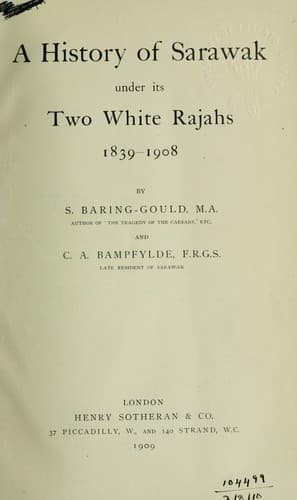
A History of Sarawak under Its Two White Rajahs 1839-1908Baring-Gould, S. (Sabine)
History
A History of Sarawak under Its Two White Rajahs 1839-1908
Baring-Gould, S. (Sabine)
Charles, Rajah of Sarawak, 1829-1917; James, Rajah of Sarawak, 1803-1868; Sarawak (Malaysia) -- History
The Sambas Malays had also been pirates, but at this period had ceased
to be such. Earl, who visited Sambas in 1834, says, that "before the
arrival of the Dutch Sambas was a nest of pirates. In 1812, having
attacked an English vessel, several British men-of-war were sent from
Batavia to attack the town. The inhabitants resisted, but were defeated,
the fort was razed to the ground, and the guns tumbled into the river."
The reoccupation by the Dutch shortly afterwards of this place,
Pontianak, and Banjermasin, put some check upon the piratical habits of
the Malays in the western and southern States,[108] but the Malays of
the eastern shores of Borneo, especially those of Koti, to the north and
north-west, were all pirates; and even the people of Bruni were imbued
with piratical habits, which were generally inherent in the Malay
character, though they were not enterprising enough to be openly
piratical, or to do more than encourage their bolder neighbours, from
whom they could obtain plunder and slaves cheaply; and near Bruni,
within the territory of the Sultan, were several piratical strongholds.
All these were under the control of half-bred Arab sherips, as also were
the Saribas and the Sekrangs.
The Lanuns are natives of the large island of Mindanau, or Magindanau,
the southernmost of the Philippine group. They were known to the
Spaniards as "Los Illanos de la laguna," and, in common with all
Muhammadans, were classed by them as Moros or Moors. On the lagoon, or
bay, of Lanun they live. They were the boldest and most courageous of
the pirates, and the most dangerous to Europeans, whom they never
hesitated to attack, not even the Dutch gunboats, and to whom, unlike
the Balenini pirates, they would never give quarter, owing to a hatred,
born of former injustice and inhumanity, received at the hands of those
whom they could only have regarded as white barbarians. They became
incorrigible and cruel pirates, looking upon piracy as a noble
profession, though Dampier, who spent six months amongst them in 1686-7,
and who was very hospitably treated, says nothing of piracy, and he
gives a full and intelligent account of the island, its inhabitants, and
products. He describes the "Hilanoons" as being a peaceable people, who
bought foreign commodities with the product of their gold mines. The
Spaniards had sometime before occupied the island, but the garrison had
to be suddenly withdrawn to Manila, in consequence of a threatened
invasion of that place by the Chinese. The Sultan then seized their
cannon, demolished their forts, and expelled their friars. Then it was
the Dutch they feared; they wished the English to establish a Factory
there,[109] and subsequently, in 1775, ceded a small island to the
H.E.I. Company for that purpose.
Though the Spanish had a settlement on the western end of the island
they were unable to keep the Lanun pirates in check, and on occasions
were severely handled by them, as were also the Dutch.
Public-domain text, read in full here on John Shaqi.
Reviews
Reviews
No reviews yet
Be the first to share your thoughts on this work.
Elsewhere in the archive
Join the Discussion
Join the discussion
Sign in to leave a comment or review.
Sign InorCreate an account