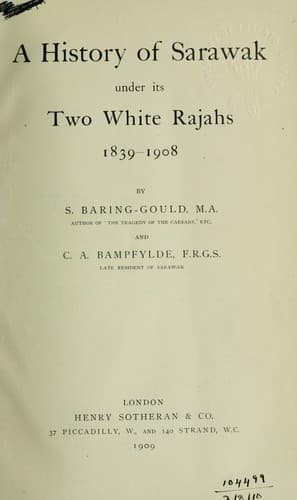
A History of Sarawak under Its Two White Rajahs 1839-1908Baring-Gould, S. (Sabine)
History
A History of Sarawak under Its Two White Rajahs 1839-1908
Baring-Gould, S. (Sabine)
Charles, Rajah of Sarawak, 1829-1917; James, Rajah of Sarawak, 1803-1868; Sarawak (Malaysia) -- History
With these pirates were associated the Bajaus or sea-gipsies, a roving
people, who lived entirely in their prahus, with their women and
children.
The vessels employed by Lanuns on marauding expeditions were sometimes
of 60 tons burden, built very sharp in the prow and wide in beam, and
over 90 feet in length. A double tier of oars was worked by slaves to
the number of 100, and the fighting men would be from 30 to 40; the
prahus of the smallest size carried from 50 to 80 in all. The bows of
the vessels were solidly built, and fortified with hard wooden baulks
capable of resisting a 6-pounder shot; often they were shod with iron.
Here a narrow embrasure admitted a gun for a 6 to a 24-pound shot. In
addition to this, the armaments consisted of several guns, usually of
brass, of smaller calibre. Sometimes the piratical fleets comprised as
many as 200 prahus, though the Lanuns usually cruised in small fleets of
20 to 30 sail. They would descend on a coast and attack any village,
sack and burn it, kill the defenders, carry away men, women, and
children as slaves, slaughter the cattle, and ravage the plantations. A
cargo of slaves captured on the east coast of Borneo would be sold on
the west coast, and those taken in the south would find a ready market
in the north, in Sulu[110] and the Lanun country. Their cruising grounds
were extensive—around the coasts of the Philippine islands, Borneo, and
Celebes to Sumatra, Java, and the Malay peninsula, through the Moluccas
to New Guinea, and even up the Bay of Bengal as far as Rangoon. In 1834,
a fleet of these Lanuns swept round the coast of a small island in the
Straits of Rhio, opposite Singapore, and killed or carried away all the
inhabitants.[111] In addition to their original home in the bay of
Lanun, they had settlements in Marudu Bay in the north of Borneo, and
towns along the west coast almost as far south as Ambong, and on the
east coast to Tungku, and on to Koti. In Marudu their chief was Sherip
Usman, who was married to a sister of the Sultan Muda of Sulu, and who
was in league with Pangiran Usup, uncle to the Sultan of Bruni, and his
principal adviser. Usman supplied the pirates with powder, shot, and
guns, and they, on returning from a piratical expedition, paid him at
the rate of four captives for every 100 rupees worth of goods with which
he had furnished them. Such captives as had been taken in the vicinity
of Bruni he would sell to Pangiran Usup for 100 rupees each, who would
then demand of their friends and relations Rs. 200 for each. "Thus this
vile Sherip, not reckoning the enormous price he charged for his goods
in the first instance, gained 500 per cent for every slave, and the
Pangiran Usup cleared 100 per cent by the flesh of his own countrymen."
Public-domain text, read in full here on John Shaqi.
Reviews
Reviews
No reviews yet
Be the first to share your thoughts on this work.
Elsewhere in the archive
Join the Discussion
Join the discussion
Sign in to leave a comment or review.
Sign InorCreate an account