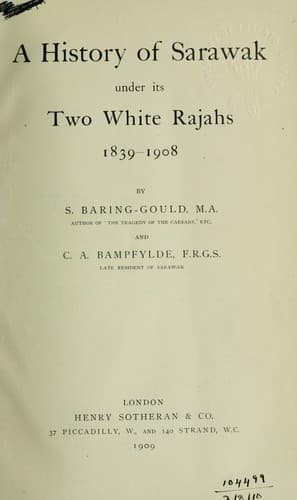
A History of Sarawak under Its Two White Rajahs 1839-1908Baring-Gould, S. (Sabine)
History
A History of Sarawak under Its Two White Rajahs 1839-1908
Baring-Gould, S. (Sabine)
Charles, Rajah of Sarawak, 1829-1917; James, Rajah of Sarawak, 1803-1868; Sarawak (Malaysia) -- History
The Natuna, the Anamba, and the Tambilan islands, which stretch across
the entrance of the China sea between Borneo and the Malay peninsula,
were common lurking haunts of the pirates. Amongst these islands they
could find water and shelter; could careen, clean, and repair their
prahus; and they were right in the track of vessels bound to Singapore,
or northward to the Philippines or China. To replenish their stores and
to obtain arms and ammunition they would sail to Singapore in
innocent-looking captured prahus, where they found a ready market for
their booty amongst the Chinese. Muskets of English make and powder from
English factories were found in captured prahus and strongholds. At
Patusan a number of barrels of fine gunpowder from Dartford were
discovered exactly as these had left the factory in England.
Against these the Rajah was powerless to take the offensive. They had to
be left to be reduced or cowed by the spasmodic efforts of British
men-of-war. What he urged, though ineffectually, was that a man-of-war
should patrol the coast and curb the ruffians. What was actually done,
but not until later, was to attack and burn a stronghold or two, and
then retire. The pirates fled into the jungle, but returned when the
British were gone, rebuilt their houses, and supplied themselves with
fresh vessels.
Near at hand were the Saribas and Sekrang Sea-Dayaks occupying the
basins of rivers of these names, the Sekrang being an affluent of the
Batang Lupar.
In each of these rivers was a large Malay community of some 1000
fighting men who lived by piracy, and who trained the numerous Dayaks,
by whom they were surrounded, to the same lawless life that they led
themselves, and guided them on their predatory excursions. Here again
both Dayaks and Malays were under the influence of Sherips, Mular, his
brother Sahap, and others. In course of time these Dayaks became expert
seamen, and, accompanied by the Malays, yearly issued forth with fleets
composed of a hundred or more bangkongs,[112] sweeping the seas and
carrying desolation along the shores of Borneo over a distance of 800
miles.
The Sea-Dayaks soon became aware of their power; and accordingly, both
in their internal government and on their piratical expeditions, their
chiefs attained an authority superior to that of the Malay chiefs, their
titular rulers.
Public-domain text, read in full here on John Shaqi.
Reviews
Reviews
No reviews yet
Be the first to share your thoughts on this work.
Elsewhere in the archive
Join the Discussion
Join the discussion
Sign in to leave a comment or review.
Sign InorCreate an account