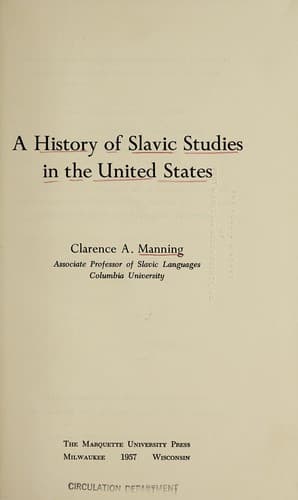
A history of Slavic studies in the United States — John Shaqi
A history of Slavic studies in the United StatesManning, Clarence Augustus
History
A history of Slavic studies in the United States
Manning, Clarence Augustus
Slavic philology -- Study and teaching; Slavs -- History -- Study and teaching
Yet the results which these individuals had achieved cannot be
overestimated. By the end of the century the leading works of Russian
literature, especially the novel, were generally known to American
readers, though all too often from English versions of French and German
translations. The appreciation of Polish culture had decreased during
the century as the memory of Pulaski and Kosciuszko faded, not without
the active cooperation of the representatives of Germany,
Austria-Hungary and Russia, which had succeeded in removing Poland from
the European map and in presenting Polish artists and writers as members
of their own states. The culture of the other Slavic peoples was even
less known and studied.
Yet when we say this, we must never forget that the situation was little
better in England. Even in France and Germany, Slavic studies had not
really found themselves. It is true that professors like Jagic, August
Leskien, E. Berneker and A. Brueckner had already started on their
brilliant careers. Morfill and later Nevill Forbes in England were
trying to hold up a standard. Even there, though, a study of the Slavic
languages and culture, as well as the presentation of the great Russian
novelists, was done in an highly out of context manner. So it also was
in the United States where interest had been concentrated in the hands
of a few select individuals who had worked on their own and for their
own pleasure.
CHAPTER 4
THE BEGINNING OF FORMAL STUDY
The second half and particularly the last quarter of the nineteenth
century was a period of rapid development in the American educational
system. Even before the Civil War, ambitious young men, dissatisfied
with the rigid curricula of the American colleges, had begun to go to
Europe, chiefly to Germany, to study and secure the degree of Doctor of
Philosophy. To a large extent the German universities came to take the
place of even Oxford and Cambridge, the chief goals of the few pre-Civil
War students who had gone to Europe.
In the same way, foreign scholars began to come to America. Again these
were largely German or at least German-trained. Some of these men
received, through some chance contact, direct invitations. Others,
forced by the shifts of German politics and the Revolution of 1848, left
their homes and joined the mass emigration to America that was already
beginning. In either case, their influence was to the good.
Public-domain text, read in full here on John Shaqi.
Reviews
Reviews
No reviews yet
Be the first to share your thoughts on this work.
Join the Discussion
Join the discussion
Sign in to leave a comment or review.
Sign InorCreate an account