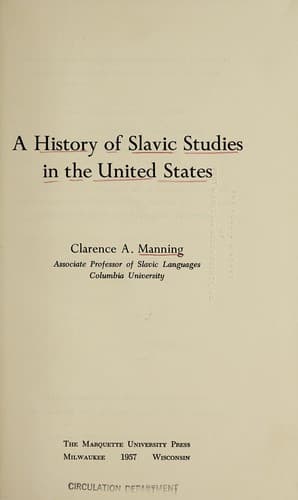
A history of Slavic studies in the United States — John Shaqi
A history of Slavic studies in the United StatesManning, Clarence Augustus
History
A history of Slavic studies in the United States
Manning, Clarence Augustus
Slavic philology -- Study and teaching; Slavs -- History -- Study and teaching
Professor Vladimir Simkhovich was appointed a professor of Economic
History at Columbia in 1904. There he continued work which he had
started at the University of Jena in 1899 on _Die Feldgemeinschaft in
Russland_ and, in 1908, _Die Bauernbefreiung in Russland_. Several
dissertations on Slavic subjects were accepted by the faculty of
political science at Columbia, such as the _Eastern Question_ by
Professor Stephan Duggan in 1902 and the _Making of the Balkan States_
by W. S. Murray in 1910.
Professor Ales Hrdlicka, the distinguished Czech anthropologist and
authority on the population of the Aleutian Islands, published several
works on the Czechs and on the _Races of Russia_ for the Smithsonian
Miscellaneous Collection for 1919.
Professor E. A. Ross, a sociologist of the University of Wisconsin, was
in Russia during the Revolution and published _Russia in Upheaval_ in
1918, _Russian Bolshevik Revolution_ in 1921, and _Russian Soviet
Republics_ in 1924.
Paul R. Radosavljevich, Professor of Experimental Psychology at New York
University, published in 1919 the two volume work, _Who are the Slavs?_
This was a serious attempt to study Slavic psychology and to identify,
if possible, features common to all Slavic nations.
A psychology professor, Will S. Monroe of the New Jersey State Normal
School in Montclair, traveled extensively in both Czechoslovakia and
Bulgaria and published _Bohemians and Czechs_ in 1910 and _Bulgaria and
its People_ in 1914.
Other men who were active, some of them students of Professor Coolidge,
were: Professor Arthur I. Andrews, Tufts College; Professor A. J.
Shipman, Princeton; Professor Sidney Bradshaw Fay, Smith College, and
Professor Bernadotte Schmitt, University of Chicago. Most of these knew
Russian or one of the Slavic languages but at this period there was no
generally accepted rule that the students of Slavic themes had to be
familiar with the original sources and many of the dissertations and
books published were by men who used materials available in French,
German, or rarely, Latin.
There were also many scholarly books by persons who had little or no
university connections. Included in these are the translations of
_Russian Poetry_ by Babette Deutsch, the wife of Dr. Yarmolinsky, and
the volumes by Julius F. Hecker.
Public-domain text, read in full here on John Shaqi.
Reviews
Reviews
No reviews yet
Be the first to share your thoughts on this work.
Join the Discussion
Join the discussion
Sign in to leave a comment or review.
Sign InorCreate an account