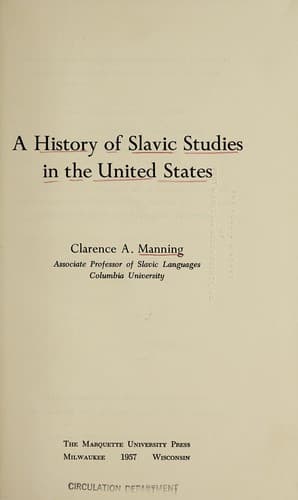
A history of Slavic studies in the United States — John Shaqi
A history of Slavic studies in the United StatesManning, Clarence Augustus
History
A history of Slavic studies in the United States
Manning, Clarence Augustus
Slavic philology -- Study and teaching; Slavs -- History -- Study and teaching
Another important event of the period, following the Bolshevik
Revolution, was the arrival in the United States of a number of Russian
emigres, on all intellectual levels. Some of them like Professors M.
Rostovtseff and A. A. Vasilieff, were among the most distinguished
Russian scholars. They easily found outstanding positions for themselves
in the leading universities and were able to exert a considerable
influence. They brought with them, in various capacities, men like
Professor George Vernadsky who were to become the heads of their
subjects during the next decades. It would take too long to list all of
these men but among them was Professor Leonid Strakhovsky, Rostovtseff’s
nephew, who taught history at Georgetown University and later moved to
the University of Maryland, then to Harvard and is now at the University
of Toronto. Professor Serge Eliseeff of Harvard was also in the field of
Far Eastern languages. For a while, Nicholas Martinovitch, formerly of
the University of Petersburg, was at Columbia in the field of Turkic
studies. Many more of the younger group have gradually secured good
positions and worked themselves up in the American university system,
sometimes with a change of their names.
The same period saw the arrival in the United States of such outstanding
Ukrainian scholars as the architect and engineer, Professor Stephen
Timoshenko of Stanford University, and his brother the economist
Volodymyr Timoshenko of the same institution, and Professor Alexander
Granovsky, an entomologist, of the University of Minnesota. Professor
Dmytro Doroshenko of the Ukrainian Free University in Prague paid
several visits to Canada. All of these men were very active in arousing
interests in Ukrainian culture as were the choral leader, Alexander
Koshits, and the sculptor, Alexander Archipenko.
There were also a few young men of Slavic origin, born and educated in
the United States, who devoted themselves to Russian fields. Among them
was Leo Pasvolsky who worked for many years at the Brookings Institute
in Washington and was the son of one of the foremost Russian editors in
the pre-war United States. Yet the situation was so discouraging that
relatively few of the really young emigres who came to the United States
after 1918 and secured an education went into Slavic studies. They
usually chose some other field and gradually lost all practical
influence in the extension of Slavic culture, though in a few cases they
did some unofficial work in their own languages.
Public-domain text, read in full here on John Shaqi.
Reviews
Reviews
No reviews yet
Be the first to share your thoughts on this work.
Join the Discussion
Join the discussion
Sign in to leave a comment or review.
Sign InorCreate an account