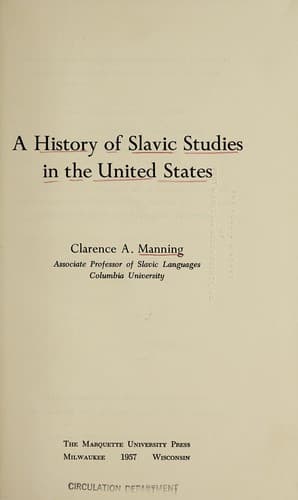
A history of Slavic studies in the United StatesManning, Clarence Augustus
History
A history of Slavic studies in the United States
Manning, Clarence Augustus
Slavic philology -- Study and teaching; Slavs -- History -- Study and teaching
The session at Columbia was attended by two regular officers of the
United States Army, Major Frank L. Hayne and Lieutenant (later Brigadier
General) Joseph A. Michela. Their attendance was made possible by the
efforts of Colonel Burnett, officer in charge of the Military Attache
Service, who, having served several terms as United States Military
Attache in Japan, insisted that officers assigned to such posts as
Moscow and Tokyo have a speaking and reading knowledge of the local
language. This had been the case of Colonel Philip Faymonville, the
first Army man to be sent to Moscow after the restoration of diplomatic
relations between the Soviet Union and the United States. In a sense, it
was almost the beginning of serious language work by the United States
Armed Services. Both Hayne and Michela later were military attaches in
Moscow, although Hayne was transferred to Finland during the
Soviet-Finnish War. Michela remained in Moscow during the greater part
of the War and participated in the removal of the capital to Kuybyshev
when the Germans approached Moscow in the summer of 1941. At Columbia,
these officers had special courses during a two year period. In the
second year they were joined by Captain Ivan Yeaton, who had previously
served during World War I in the Siberian Expedition under General
Graves. Other officers were later added to the group but as World War II
approached, the entire project was transferred to Harvard University.
The thirties also witnessed the beginning of a systematic interest in
Russian studies by the American Council of Learned Societies. This group
had previously considered the need for developing studies in specialized
fields and had approached foundations to secure money for limited
projects. It had been successful in fostering work in Chinese and in
completing at least a preliminary survey of American resources in the
field. It then turned its attention to Russian and established a
committee to study the general status of Russian studies. Professor
Cross was secretary of this important committee for several years.
Through the activities of the American Council, coordination of work by
the various universities and colleges, was accomplished. This was but
the beginning of a process which was to be greatly intensified during
the War.
In the thirties, the University of Wisconsin began to offer courses in
Polish. Elaborately planned, Professor Joseph Birkenmeyer from the
University of Krakow was invited to direct the work. Unfortunately, he
returned to Poland just on the eve of World War II, but the work was
continued successfully.[37] The department at Wisconsin was established
primarily through the influence of the Polish population of the state.
Public-domain text, read in full here on John Shaqi.
Reviews
Reviews
No reviews yet
Be the first to share your thoughts on this work.
Join the Discussion
Join the discussion
Sign in to leave a comment or review.
Sign InorCreate an account