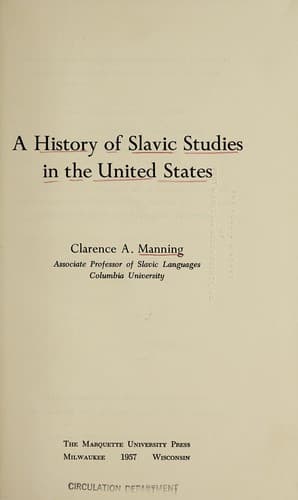
A history of Slavic studies in the United StatesManning, Clarence Augustus
History
A history of Slavic studies in the United States
Manning, Clarence Augustus
Slavic philology -- Study and teaching; Slavs -- History -- Study and teaching
When we consider the state of affairs as a whole on the eve of World War
II it is apparent that no important university or college had
established an adequate course in Slavic languages and literatures other
than those which had done so by the end of World War I. This does not
mean that the period between the wars was lost. The departments at all
the major centers were better equipped than they had been twenty years
before; they had larger libraries, better trained instructors and what
is more, they were attracting more serious students. Further, there
were, in the United States, a considerable number of men who had had
personal experience and acquaintance with the Slavic and adjacent
countries. There were real experts in almost every field of Slavic
studies and there had been a large output of books on the languages,
literatures and histories of the Slavic nations.
Of course, Russian predominated. Yet it is noteworthy that during the
twenties and thirties when American institutions were overrun with
would-be Communists, the Slavic departments, which might have seemed the
most vulnerable, somehow escaped with the least amount of trouble. They
had not taken sides in the fervent polemics of the period that were
carried on with more heat than light, and while there were a number of
men who had studied or visited the Soviet Union, few, if any, had become
seriously infected with Communism.
They had, however, continued to repeat the old traditional formulas set
out by Russian scholarship before the Revolution, arbitrarily neglecting
all aspects of the nationality problem in the Soviets, treating Russia
as a single unified country, without regard for the mixed elements of
her population or the Soviet division of the republics by an official
policy of differentiation between the peoples.
The most unsatisfactory aspect of the period concerned the non-Russian
Slavic tongues and histories. This was unfortunate, for it tended to
give instruction in the major centers a Russian, if not Soviet,
orientation, a fact which would cause repercussions in the following
period.
Among the Slavic communities, some leaders were beginning to understand
better the peculiar problems of the American educational system, and
though they had not yet come to cooperate actively, they were rapidly
becoming aware that there was serious work being done. Their own
institutions were improving. They were securing more American-trained
teachers, even if they were members of the groups, and many second
generation Slavs were rising to prominence.
Thus, the period represented a marked deepening, rather than an
expansion, of efforts. Slavic languages and history were no longer
considered merely artificial and exotic; the way was cleared for a
period of rapid expansion.
CHAPTER 7
SLAVIC STUDIES SINCE 1939
Public-domain text, read in full here on John Shaqi.
Reviews
Reviews
No reviews yet
Be the first to share your thoughts on this work.
Elsewhere in the archive
Join the Discussion
Join the discussion
Sign in to leave a comment or review.
Sign InorCreate an account