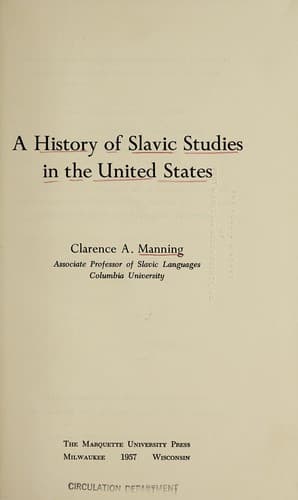
A history of Slavic studies in the United StatesManning, Clarence Augustus
History
A history of Slavic studies in the United States
Manning, Clarence Augustus
Slavic philology -- Study and teaching; Slavs -- History -- Study and teaching
In the period of tension which followed the Munich Agreement of 1938,
the opening of World War II, and the period of Nazi-Soviet cooperation,
Slavic studies in the United States, as well as the studies of the
neighboring East European countries began to receive more serious
consideration. A period of more active interest began. Because
developments during World War II have continued since the ending of
hostilities, it is difficult to draw a hard and fast line between the
War and post-war period, largely because of the Cold War and the
establishment of the Iron Curtain or, better yet, the recognition that
there were tremendous gaps between the thinking of the Western free
world and the Soviet dominated areas.
On the surface, the reactions in 1939 differed little from those in
1914. This is well illustrated by the fact that at the annual opening
exercises of Columbia University in 1939, President Nicholas Murray
Butler repeated large extracts from his talk of 1914 on a similar
occasion. Yet, the attention of the American public was more sharply
focused on events in Eastern Europe than it had been in 1914 and the
colleges and universities during the preceding twenty-five years had
provided a larger nucleus of trained men. The events of the first months
showed, however, that far too many of these trained men were still bound
to the thinking of the past and were not prepared to take into account
recent developments on a global, and even on an East European, scale.
Such short-sightedness prevented adequate consideration of the situation
as it unfolded day by day.
The old myth that Russia was a single country inhabited by a single
people, with boundaries defined long ago, proved remarkably vital.
President Wilson’s formulation of a Russian policy in 1918, recognizing
the need of the Russian people to choose their own form of government,
was still accepted and even the colleges and universities paid little
attention to the structure of the Soviet Union as it saw itself. The
American people and their government continued to use the word Russian
as a synonym for Soviet Union and were puzzled, as they had been in
1917, by the movements that arose in the territory. As in 1917, Finland
stood out as a distinct nationality, but the popular reaction to the
annexation of the Baltic republics was marked as much by confusion as by
indignation. Supposed “experts” even found grim relief in the fact that
after 1939 the borders of Germany and “Russia” were touching and this
seemed to confirm the validity of the pre-1914 frontiers.
Public-domain text, read in full here on John Shaqi.
Reviews
Reviews
No reviews yet
Be the first to share your thoughts on this work.
Elsewhere in the archive
Join the Discussion
Join the discussion
Sign in to leave a comment or review.
Sign InorCreate an account