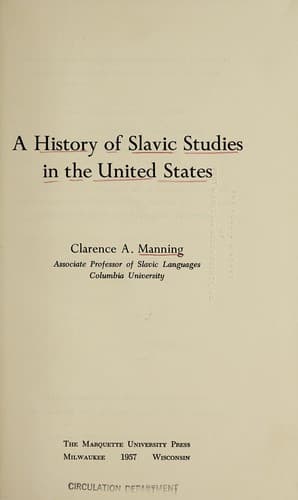
A history of Slavic studies in the United StatesManning, Clarence Augustus
History
A history of Slavic studies in the United States
Manning, Clarence Augustus
Slavic philology -- Study and teaching; Slavs -- History -- Study and teaching
Thus the crisis tended to emphasize again the importance of Russian
history and the Russian language. In a sense this was justified. The
force of events had made the Russian language predominant in Eastern
Europe and the leaders of the USSR were almost exclusively Russian,
except the Georgian Stalin, who regularly espoused the Great Russian
cause for foreign consumption. All tendencies to stress the opponents of
Moscow and their cultures ended abruptly with the Nazi attack on the
Soviet Union and continued in the following period of Soviet-democratic
cooperation. Such emphasis on the Russian character of the USSR was
furthered by many of the Russian emigres, who at the height of the war,
were only too ready, whatever their political convictions, to serve the
cause of Mother Russia, a policy which was fostered by Stalin’s clever
use of Russian slogans.
Many British and American authorities zealously compared the German
attack on the Soviets in 1941 to the German advance in 1918 after the
Soviet Revolution. A bitter propaganda attack was started, both inside
and outside the universities, against all national groups from the old
Russian empire having separatist aspirations. The old equation that all
who were not pro-Communist were pro-Nazi was repeated, especially after
1941. The Ukrainians received the worst criticism but they were not
alone. Even though the United States government refused to recognize the
seizure of the Baltic states, President Roosevelt acceded to the demands
of Stalin and allowed him to sign the Atlantic Charter. They did not
grant this to the representatives of the occupied countries, lest they
break the friendship with that great anti-Nazi power—“Russia.” Under
such conditions, lectures arranged by Professor Manning at Columbia
University in the spring of 1941, with the aid of the Ukrainian National
Association and a number of distinguished professors of Eastern Europe,
evoked severe criticism from many anti-Nazi radio commentators who
followed the whims of popular sentiment.
The chief counterweight to this tendency was the arrival in the United
States of many distinguished scholars who had escaped the holocaust of
Nazi rule and the direct impact of Soviet power on Slavic scholarship.
The circumstances of the peaceful occupation of Prague in the spring of
1939 made it difficult, if not impossible, for many Czech professors to
leave. The chief exceptions were Professor Otokar Odlozilik and
Professor Roman Jakobson who were outside the country when the storm
struck.
Public-domain text, read in full here on John Shaqi.
Reviews
Reviews
No reviews yet
Be the first to share your thoughts on this work.
Elsewhere in the archive
Join the Discussion
Join the discussion
Sign in to leave a comment or review.
Sign InorCreate an account