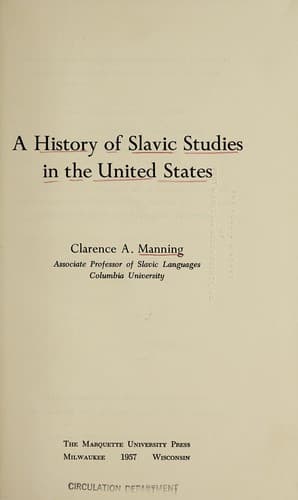
A history of Slavic studies in the United StatesManning, Clarence Augustus
History
A history of Slavic studies in the United States
Manning, Clarence Augustus
Slavic philology -- Study and teaching; Slavs -- History -- Study and teaching
As an example, consider Columbia University’s efforts to secure a
balanced course. When Professor Ernest J. Simmons joined the staff, in
1946, as professor of Russian literature and Chairman of the Department
of Slavic Languages, as it was now renamed, he hoped to build a broad
program. The department was informally divided into four sections:
Slavic and Russian philology; Czech and Slovak; Polish, and South
Slavic. To help defray expenses, the university, reversing the policy
formulated by President Butler after the unpleasant developments of the
World War I period, sought from the lesser Slavic lands, a yearly
subsidy to pay the salary of a distinguished professor. This was easily
secured from both Poland and Czechoslovakia and Professor Roman Jakobson
was appointed the Thomas G. Masaryk Professor of Slavic Philology, and
Professor Manfred Kridl was named the Adam Mickiewicz Professor of
Polish. Arrangements were made without considering developments which
might be caused by the Communists, and similar agreements were made with
many countries of the Near and Middle East. The experiment was hardly
satisfactory. After the Communist coup in Czechoslovakia, the new regime
imposed such conditions that maintenance of the chair was impossible.
Poland more slowly followed the same course. Despite other arrangements
with less possible political interference, made by the university, the
number of students in the Czech, Slovak, Polish and South Slavic
sections of the department has been scarcely larger than it was between
the wars. There was no attempt, at Columbia, to break the traditional
separation between the faculties of philosophy and political science, or
establish a single department for all Slavic, or even all Russian,
instruction. Russian history, under Professor Geroid Robinson, continued
to develop as it had, just as other areas of study continued under the
faculty of political science.
Development at Harvard was somewhat different. There, after the interim
period following the death of Professor Cross, Professor Roman Jakobson
came to Cambridge in 1949, with a number of experts in Slavic fields. At
about the same time, work in all Slavic subjects was, at least
partially, consolidated and Professor Karpovich was named to the Curt
Hugo Reisinger Chair of Slavic Languages and Literatures, in addition to
his work in history.
At the University of California development was severely affected by the
death of Professors Patrick and Kaun, until the staff was rebuilt by the
appointment of Professor Gleb Struve and Waclaw Lednicki, and the
promotion of Professor Oleg Maslenikov.[41] There was no attempt to
integrate the work in history under Professor Robert J. Kerner, although
the department broadened with an increase of students.
Public-domain text, read in full here on John Shaqi.
Reviews
Reviews
No reviews yet
Be the first to share your thoughts on this work.
Elsewhere in the archive
Join the Discussion
Join the discussion
Sign in to leave a comment or review.
Sign InorCreate an account