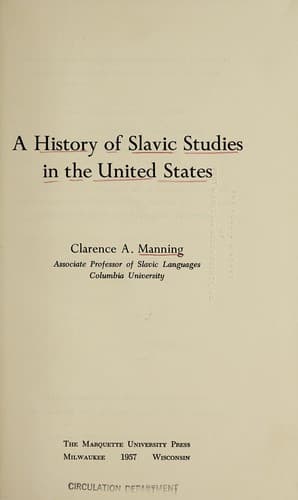
A history of Slavic studies in the United StatesManning, Clarence Augustus
History
A history of Slavic studies in the United States
Manning, Clarence Augustus
Slavic philology -- Study and teaching; Slavs -- History -- Study and teaching
Many of the newly arrived scholars are already playing an important role
in the development of Slavic studies and in the reorganization of some
of the older departments. It would take too long to list all who have
found important posts. Professor Oskar Halecki is developing the study
of Polish history at Fordham University. Professor Roman Smal-Stocki at
Marquette University has taken a prominent part in the formation of a
Slavic Institute there. By such publications as _The Nationality Problem
of the Soviet Union_, he is helping acquaint the American public with
the dangers of open, as well as secret, Communism in the United States,
besides exposing the inaccuracy of the American concept that all
citizens of the former Russian empire are Russians by blood, feeling and
culture. There is, in addition, the work of Professor George Shevelov in
comparative philology at Columbia University, and that of Professor
Dmytro Chyzhevsky at Harvard, which emphasizes the older Ukrainian
literature.
The rise of recently arrived Slavic scholars and the influence of
transplanted organizations of Slavic scholarship was earnestly needed by
American Slavic scholarship and, in fact was forced by the surprising
number of deaths during the war period. Development in the different
institutions has been conditioned, of course, by the general traditions
and spirit of each school. While growth has been rapid, it cannot be
said that all results have been unqualifiedly happy or successful,
partly because of the sporadic interest by both faculty and students in
the field as a whole. Slavic subjects (not to speak of the closely
associated non-Slavic languages like the Ural-Altaic groups, modern
Greek and Romanian, all of which have strong Slavic overtones) are
extremely broad and diverse. Yet for the average American student,
Slavic and Russian are too exclusively identified. Even interest in
Russian has been chiefly limited to either pure philology or, more
frequently, Russian literature of the nineteenth or twentieth centuries.
Public-domain text, read in full here on John Shaqi.
Reviews
Reviews
No reviews yet
Be the first to share your thoughts on this work.
Elsewhere in the archive
Join the Discussion
Join the discussion
Sign in to leave a comment or review.
Sign InorCreate an account