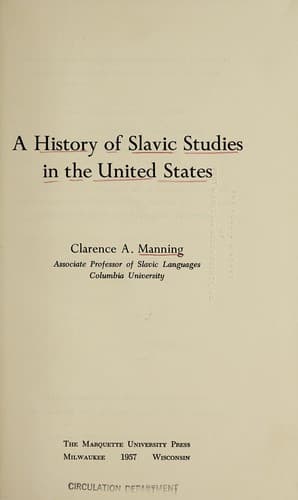
A history of Slavic studies in the United StatesManning, Clarence Augustus
History
A history of Slavic studies in the United States
Manning, Clarence Augustus
Slavic philology -- Study and teaching; Slavs -- History -- Study and teaching
The Russian Institute, established in 1946 with the assistance of
the Rockefeller Foundation, has two major objectives: the
development of _research_ in the social sciences and the humanities,
as they relate to Russia, and the training of a limited number of
well-qualified Americans for scholarly or professional careers, as
Russian-Soviet specialists in business, in finance, in journalism,
in various branches of government service, and in academic research
and teaching in the social sciences and in literature. It is
believed that such prospective specialists should acquire (a) a
broad and thoroughly integrated knowledge of Russia and the Soviet
Union; (b) command of a well-developed specialty in a selected
academic discipline, as applied to that country; and (c) a broad
training in the more general aspects of this selected discipline. To
this end, each candidate for the two year certificate will pursue
certain survey courses on Russia, while giving special emphasis,
within the Institute, to one of five fields: Russian history,
economy, government and law, foreign relations, the social and
ideological aspects of literature. At the same time, the candidate
will be expected to follow outside the Institute, a parallel program
of work in the graduate school or department of the University that
is most closely allied with his Russian specialty within the
Institute.
All of these institutes, wherever they have been founded and whether
they are Institutes, Studies or Programs have been faced with the same
fundamental dilemma: how is the term “Russia” to be defined? A certain
number of scholars, who have been labeled by Professor Lev Dobriansky of
Georgetown University as the “Russia Firsters,” have stubbornly insisted
that it was their duty to devote themselves to the study of Russia in
the traditional sense of the word, i.e. the consideration of Russian
culture, history and economics without regard to the linguistically and
culturally heterogeneous character of the old Russian empire. To
students of this school, every person within the old Russian empire is a
Russian, whether their studies concern economics or concentration camps.
They refuse to separate the statistics in any way that might show
increased pressure on the non-Russian peoples by the Soviet government.
They feel themselves free to do this, even though Stalin himself after
World War II specifically attributed the victory of the Soviet Union to
the loyalty of the Great Russians, i.e. Russians in the narrower sense
of the word.
Public-domain text, read in full here on John Shaqi.
Reviews
Reviews
No reviews yet
Be the first to share your thoughts on this work.
Elsewhere in the archive
Join the Discussion
Join the discussion
Sign in to leave a comment or review.
Sign InorCreate an account