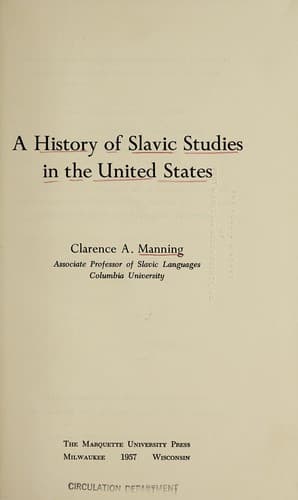
A history of Slavic studies in the United StatesManning, Clarence Augustus
History
A history of Slavic studies in the United States
Manning, Clarence Augustus
Slavic philology -- Study and teaching; Slavs -- History -- Study and teaching
This attitude, despite the prominence of its supporters, has been
steadily opposed by those students who stress the cultural and
linguistic differences which existed in the old Russian empire as well
as in the modern Soviet Union. These students emphasize the similarities
between the Russian and Soviet concepts of dominance of the Great
Russians, and argue for a proper recognition of the oppressed nations of
the USSR who sought their independence during the Revolution and have
since been restrained by force of arms to adopt Communism. They
accordingly see in the restoration of the political independence of
these nations the best answer to the Communist menace to freedom. This
viewpoint has been expressed by Professor Roman Smal-Stocki, and by
James Burnham, formerly of the Department of Philosophy of New York
University, who in all his writings has stressed the need to eliminate
the new Russian Communism.
A further requirement of this in a historical survey is expressed by a
Russian in speaking of the failure of the anti-Communist movements
during the Civil Wars:
Those who were adverse to the new (Communist) regime could thus be
divided into two very different groups; one comprising the
property-owning classes (who had been deprived of their all by the
Bolsheviks), the officers, the civil servants and all those devoted
to the ideals of the Russian State as constituted before the October
Revolution; the other, the national separatist groups, which desired
complete separation from Russia. It is easy to see that, no matter
how antagonistic these two groups might be to Communism, their aims
were absolutely dissociated. The unity of the Russian State could
only be reestablished in one of two ways: either by a restoration of
the Monarchy or by federation. Neither alternative appealed to the
anti-Bolshevik groups; and this circumstance explains the absence of
cooperation in the Civil War which broke out in many parts of the
country in 1918. It must be noted also, that the majority of the
population, the peasantry, stood entirely aloof from the activities
of both groups, and remained during the initial stages of the Civil
War absolutely neutral.[43]
With the practical elimination of the monarchist influences, the line is
still drawn with the greatest bitterness between the so-called Russian
democratic elements who insist upon the unity of Russia and the
representatives of the non-Russian peoples, especially the Ukrainians,
Baltic, Caucasian and Turkestanian nations. During the first post-war
years this latter tendency was little regarded in the American
universities and even now is less well represented than it should be;
but recent years have seen the publication of several studies such as
John Reshetars’s _Ukrainian Revolution_ and John A. Armstrong’s
_Ukrainian Nationalism_ (1939–1943).
Public-domain text, read in full here on John Shaqi.
Reviews
Reviews
No reviews yet
Be the first to share your thoughts on this work.
Elsewhere in the archive
Join the Discussion
Join the discussion
Sign in to leave a comment or review.
Sign InorCreate an account