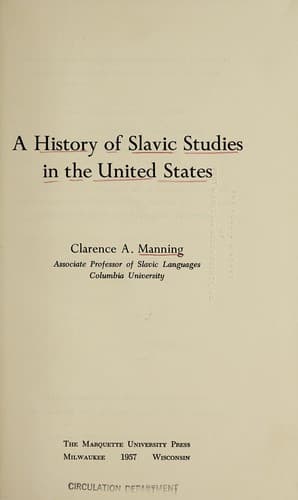
A history of Slavic studies in the United StatesManning, Clarence Augustus
History
A history of Slavic studies in the United States
Manning, Clarence Augustus
Slavic philology -- Study and teaching; Slavs -- History -- Study and teaching
Studies in the United States in these fields must find, despite the many
obstacles, a new path, acquire a new breadth of vision, and work out a
new outline wherever the old has been shown to be deficient. This can
only be done by cooperation among both scholars and institutions. Though
the leading colleges and universities have found during the past century
their own methods for departmentalizing their courses and faculty, there
is hardly one which cannot adapt its resources to contribute to the
common cause. We will therefore content ourselves with sketching briefly
some of the problems, and their possible solutions, in the field of
organization.
_I. Integration in American Consciousness_
At the present time, educated Americans seem to find it impossible to
integrate the concepts that have been forced upon them by events since
1914. The older generation, and too large a part of the younger, view
the expanded practical concern for Eastern Europe and Asia as a serious
and troublesome addition to the range of knowledge which it is compelled
to acquire. This attitude has been fostered by the way in which the
expansion has occurred. Under the pressure of World War II, and its
accompanying developments, the government and the foundations alike have
been spending money to train men in present-day problems and have looked
askance at what we may call basic work in the evolution of the
situation.
Let us glance at this for a moment. Courses in ancient history, chiefly
of Greece and Rome, are an established part of all college and
university curricula and are even found in many high schools. Yet
invariably, these courses fail to discuss Greece and Greek culture after
the rise of Philip of Macedon and the Roman conquest of Greece. Studies
of the Roman Empire rarely extend beyond the reigns of Diocletian and
Constantine, where they are lost in vagueness about the Dark Ages and
the barbarian migrations. Even in the earlier period, almost no
attention has been given to vestiges of Greek and Roman culture outside
of Greece, Asia Minor and the Roman possessions in the West.
Public-domain text, read in full here on John Shaqi.
Reviews
Reviews
No reviews yet
Be the first to share your thoughts on this work.
Elsewhere in the archive
Join the Discussion
Join the discussion
Sign in to leave a comment or review.
Sign InorCreate an account