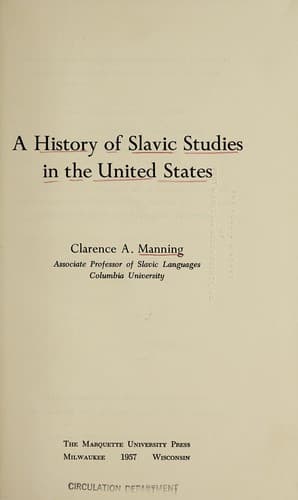
A history of Slavic studies in the United StatesManning, Clarence Augustus
History
A history of Slavic studies in the United States
Manning, Clarence Augustus
Slavic philology -- Study and teaching; Slavs -- History -- Study and teaching
We can be very sure, the world and human nature being what it is, that
there will be no such reaction against foreign languages as there was
during and after World War I. There are already signs that the number of
students has dropped to the point where it will remain stationary, or
from which it will perhaps rise slightly, during the next years.
The study of Slavic and East European subjects has followed a very
definite pattern in the last ten years with its shifts of emphasis
reflecting the changes that have taken place in that part of the globe.
It has followed political and economic relationships of the United
States and we can be confident that it will continue to do so.
Thus, since the beginning of World War I, the picture of Slavic and East
European studies in the United States has changed markedly. The
prospects today are far brighter than they ever have been. The
foundations have been laid and it only remains to build a superstructure
to fit into American life and at the same time present a consistent and
coherent picture of what that American life, and Slavic studies, really
need. The first period of test is over. Now is the time to present
Slavic scholarship to the American public and the scholarly world in
such a form that it can be assimilated and incorporated in the
intellectual life of the nation, and at the same time take account of
the possibilities offered by the large section of the population with
Slavic traditions.
CHAPTER 8
THE FUTURE TASKS OF SLAVIC AND EAST EUROPEAN STUDIES
It is obviously impossible, under present conditions in America, even to
dream of offering any outline for a definite organization of studies of
that large area east of Scandinavia, Germany and Italy. We are dealing
with several linguistic and cultural entities which historically have
been subjected to widely differing influences. Especially in the field
of history and of culture in general, the old notion that a boundary
could be drawn between the Roman Catholic and Orthodox Churches, or
between the Christian and the Islamic Worlds, is definitely antiquated.
It was non-existent during the earlier periods of history although it
was partially valid for a few centuries. Even at the height of religious
separation, the Slavic World was itself divided, the Western Slavs and
some Southern Slavs on one side and the Eastern and most Southern Slavs
on the other. Today, with the general movements that are sweeping both
Europe and Asia, these lines are obliterated.
We are forced, thus, to recognize a far more complicated situation than
seemed possible even a few decades ago when the early students of Slavic
blindly, though sincerely, followed either the German or the Russian
cultural views of the area.
Public-domain text, read in full here on John Shaqi.
Reviews
Reviews
No reviews yet
Be the first to share your thoughts on this work.
Elsewhere in the archive
Join the Discussion
Join the discussion
Sign in to leave a comment or review.
Sign InorCreate an account