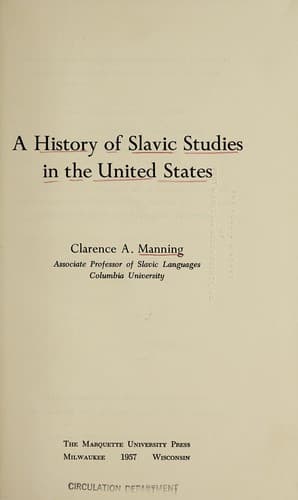
A history of Slavic studies in the United StatesManning, Clarence Augustus
History
A history of Slavic studies in the United States
Manning, Clarence Augustus
Slavic philology -- Study and teaching; Slavs -- History -- Study and teaching
Thus all the peoples of Eastern Europe disappear from European history
shortly after the time of Constantine and do not reappear until the
foundation of St. Petersburg and the development of the Eastern Question
in the late eighteenth century. Even the national struggles in Vienna
during the reign of Francis Joseph II are not evaluated, and far too
many would-be-students of Eastern Europe are still under the impression
that movements for national independence during World War I and the
Russian Revolution arose out of thin air.
The complicated events of the last decades pre-empt the concentration of
students and give them little time to grasp the background which
underlay the past and gave rise to the complexities of the present.
It would be presumptuous to expect adequate and detailed knowledge of
Eastern history to be added to the intellectual burden of all students,
even though it would be desirable. The most that can be hoped is that
students and scholars interested in this field will be able eventually
to focus more attention, in the general curricula, on a few of the major
trends that worked openly and secretly in Eastern history for over a
thousand years, culminating in the present situation.
The last years have seen a few attempts, like those of the late Dr.
Bilmanis, Minister of Latvia in Washington, to prepare a history of
Latvia. We now have histories of Lithuania, Poland, Czechoslovakia and
two or three of Ukraine. But there is still lacking a general survey
presenting in readable, popular and general form the outstanding
developments in the Slavic area. The development of such a synthesis of
the East European culture, in a form that could be included with the
more detailed studies of the Western countries, would go far in
overcoming the vague and unrealistic ideas which are fostered either by
ignorance or by the propagandistic works of the formerly dominating
nations.
When we remember that it was nearly the end of the seventeenth century
before Eastern Europe acquired the form that it had on the eve of World
War I and that this order was seriously challenged throughout the
nineteenth century, we can see the necessity of a complete revision of
many of the established and traditional concepts. Such a need must be
recognized by the educational leaders as a whole, for Eastern Europe has
greatly and consistently influenced the West. No greater step forward
can be taken than to emphasize this historical fact and to show the
important role of Eastern Europe, both positively and negatively, in
shaping the world as we knew it at the beginning of the twentieth
century.
_II. The Divisions of the Area_
Public-domain text, read in full here on John Shaqi.
Reviews
Reviews
No reviews yet
Be the first to share your thoughts on this work.
Elsewhere in the archive
Join the Discussion
Join the discussion
Sign in to leave a comment or review.
Sign InorCreate an account