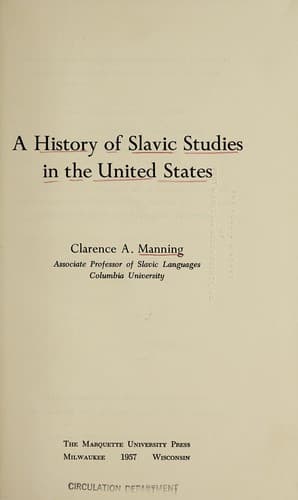
A history of Slavic studies in the United StatesManning, Clarence Augustus
History
A history of Slavic studies in the United States
Manning, Clarence Augustus
Slavic philology -- Study and teaching; Slavs -- History -- Study and teaching
Awakening the American intellectual world to the need for reassessing
its concept of Eastern Europe is, of course, an essential problem for
Slavic students, but it can be fully accomplished only in cooperation
with those individuals and institutions concerned with the general
outline of human history. Far more than a mere multiplication of
courses, of lectures and of journals is needed. Yet if we assume that
steps are being taken toward this end, there still remains the very
pertinent question of what divisions and subdivisions of the area are to
be used in any detailed study. It is at this moment that we come face to
face with the tremendous historical and linguistic complications.
First considering linguistics, Slavic easily can be placed at the
center, for the greater number of the inhabitants of Eastern Europe
speak one of the Slavic tongues. The traditional point of view, which is
now being challenged by linguists, is to divide the Slavs into Western
(Czech, Slovak, Polish and Lusatian), Southern (Serb, Croatian, Slovene
and Bulgarian) and Eastern (Great Russian, Ukrainian and Byelorussian),
and to emphasize common linguistic aspects.
This is of advantage from the strictly philological point of view; it is
less valid when considering culture and history and the influence
exerted throughout the last millenium by the neighboring states and
cultures. As has been noted already, the constantly shifting line
between Eastern and Western churches cuts directly across the Slavic
world. On one side are the Czechs, Slovaks, Poles and Croatians, all of
whom have been primarily under Western influence. On the other are the
rest of the southern and eastern Slavs who have drawn their original
inspiration from Byzantium and have then undergone, in varying degrees,
cultural influence from the Latin and Germanic west, the Scandinavian
north, the Mongol and Tatar east and the Turkish south. Ukraine, and to
a lesser degree Byelorussia (Whiteruthenia), have felt a consistently
strong Western influence throughout their history. Western influence
among the Serbs has been more spasmodic, while Russia (Moscow) remained
relatively free from such influences almost until the time of Peter I.
Public-domain text, read in full here on John Shaqi.
Reviews
Reviews
No reviews yet
Be the first to share your thoughts on this work.
Elsewhere in the archive
Join the Discussion
Join the discussion
Sign in to leave a comment or review.
Sign InorCreate an account