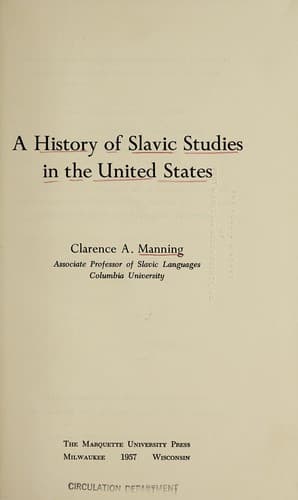
A history of Slavic studies in the United StatesManning, Clarence Augustus
History
A history of Slavic studies in the United States
Manning, Clarence Augustus
Slavic philology -- Study and teaching; Slavs -- History -- Study and teaching
We can be sadly confident that it will be some time before undergraduate
courses in East European history and culture will everywhere acquire a
proper direction and clear acceptance. But year by year, as these
studies expand in the colleges, an increasing number of students are
affected and Slavic studies are coming closer and closer to the academic
level and seriousness of the older disciplines. This offers hope for the
future and, while we cannot expect a Slavic department to become one of
the numerically larger departments, it can rise to its opportunities and
exercise its functions both in training specialists and in broadening
the knowledge of a larger and larger number of students. The lag in
Slavic studies is diminishing with each year and it will soon vanish
entirely if developments of the present day are carefully regarded.
_IV. Language Instruction_
The first task of a Slavic or East European language department is of
course to teach the language. It should be taken for granted that any
person who claims to be a specialist in the history and culture of any
country should be able to read, write, speak and understand its
language. The language courses in any department are intended to satisfy
these requirements. This however is a goal and the merest contact with
even good students will show how far it is from being fully realized.
Yet it must be the goal even though we accept something far short of it
as that which can be reasonably attained.
There is no easy way to learn a foreign language and to maintain fluency
in it. And fluency can be best secured by a constant use of the
language, hardly possible in the United States despite the aspiration of
the student. Somewhere, somehow there must be a compromise.
There are, of course, scattered individuals like the late Professor John
Dyneley Prince, who seemed to have a special gift for speaking foreign
tongues. As a matter of fact, Prince built his entire scholarly and
political career on this inborn gift. His knowledge of spoken tongues
was fantastic, but it should be recognized that he maintained it only by
a constant preoccupation with language. The time that others spent on
bridge and other hobbies, he dedicated to reading dictionaries and
annotating grammars. He continued, so long as his health allowed, the
labor which made it possible for him to perform his almost incredible
feats. Men like Prince are exceptional, but they emphasize the fact that
there is no single road to success. Every individual learns languages in
his own way and hence there can easily be a wide divergence of
educational methods recommended.
Public-domain text, read in full here on John Shaqi.
Reviews
Reviews
No reviews yet
Be the first to share your thoughts on this work.
Elsewhere in the archive
Join the Discussion
Join the discussion
Sign in to leave a comment or review.
Sign InorCreate an account