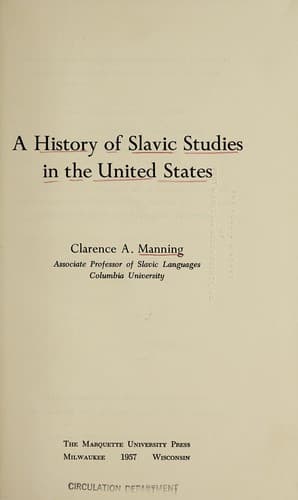
A history of Slavic studies in the United StatesManning, Clarence Augustus
History
A history of Slavic studies in the United States
Manning, Clarence Augustus
Slavic philology -- Study and teaching; Slavs -- History -- Study and teaching
On the other hand, with the number of available translations of nearly
all the prominent Russian authors of the nineteenth and twentieth
centuries, there is no reason why courses on Russian literature in
translation should not be offered. The material can be easily gathered
to give an adequate picture of the development of the literature for the
non-specialist. Whether this is done as part of a general course, or as
a special course, will depend upon the program of the institution but it
will benefit not only the general student but also the person who is
endeavoring to learn the language.
The problem is more complicated for the other East European languages.
Perhaps Polish literature is the only one that has been translated with
even near minimal adequacy. Still, there are a number of translations
from the Czech, especially from Karel Capek, the popular dramatist who
was active before World War II. There are some good Ukrainian
translations, especially of poetry done by the late Percival Cundy and
the selections already in English give a fair representation of all the
major Ukrainian authors. The literatures of the other Slavic groups are
still poorly represented in translations.
There is a real need therefore for the preparation of a series of
anthologies in translation, not only from the Slavic languages, but also
from the other literatures of East Europe. There may be difficulties in
securing publication of such works, and hesitation in introducing them
with success into the various courses, but there is no reason why any
college library should not work to build a collection of such works,
even if it is not interested in expanding its study in this field.
Where there are courses in one or more of the languages of the area, it
will be, of course, easy to prepare courses on the literature with
readings in the original. Yet, these can never replace the full need for
courses in translation or courses in which the originals are
supplemented by translations.
The same applies to courses in the fine arts, especially music and
painting, both of which have flourished in Slavic lands. There are
special difficulties here that are not present in the literature, for in
the past, and especially the nineteenth century, most of the Slavic
artists appeared in the Western World as either Russian, Austrian or
Italian. As such, their contributions have been hidden even beyond their
own desires, for in 1918 the world discovered that many artists, who had
been invited as representatives of the dominating empires, rebelled and
proudly declared themselves Poles or Czechs, much to the surprise of
their audiences.
Public-domain text, read in full here on John Shaqi.
Reviews
Reviews
No reviews yet
Be the first to share your thoughts on this work.
Elsewhere in the archive
Join the Discussion
Join the discussion
Sign in to leave a comment or review.
Sign InorCreate an account