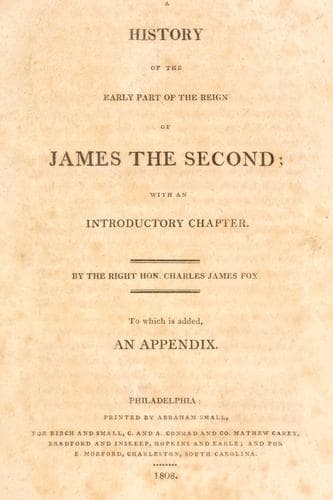
A History of the Early Part of the Reign of James the Second — John Shaqi
A History of the Early Part of the Reign of James the SecondFox, Charles James
History
A History of the Early Part of the Reign of James the Second
Fox, Charles James
Great Britain -- History -- James II, 1685-1688
If we consider this question of example in a more extended view, and look
to the general effect produced upon the minds of men, it cannot be
doubted but the opportunity thus given to Charles to display his firmness
and piety has created more respect for his memory than it could otherwise
have obtained. Respect and pity for the sufferer on the one hand, and
hatred to his enemies on the other, soon produce favour and aversion to
their respective causes; and thus, even though it should be admitted
(which is doubtful) that some advantage may have been gained to the cause
of liberty by the terror of the example operating upon the minds of
princes, such advantage is far outweighed by the zeal which admiration
for virtue, and pity for sufferings, the best passions of the human
heart, have excited in favour of the royal cause. It has been thought
dangerous to the morals of mankind, even in fiction and romance, to make
us sympathise with characters whose general conduct is blameable; but how
much greater must the effect be when in real history our feelings are
interested in favour of a monarch with whom, to say the least, his
subjects were obliged to contend in arms for their liberty? After all,
however, notwithstanding what the more reasonable part of mankind may
think upon this question, it is much to be doubted whether this singular
proceeding has not as much as any other circumstance, served to raise the
character of the English nation in the opinion of Europe in general. He
who has read, and still more, he who has heard in conversation
discussions upon this subject by foreigners, must have perceived that,
even in the minds of those who condemn the act, the impression made by it
has been far more that of respect and admiration than that of disgust and
horror. The truth is that the guilt of the action--that is to say, the
taking away of the life of the king, is what most men in the place of
Cromwell and his associates would have incurred; what there is of
splendour and of magnanimity in it, I mean the publicity and solemnity of
the act, is what few would be capable of displaying. It is a degrading
fact to human nature, that even the sending away of the Duke of
Gloucester was an instance of generosity almost unexampled in the history
of transactions of this nature.
Public-domain text, read in full here on John Shaqi.
Reviews
Reviews
No reviews yet
Be the first to share your thoughts on this work.
Join the Discussion
Join the discussion
Sign in to leave a comment or review.
Sign InorCreate an account