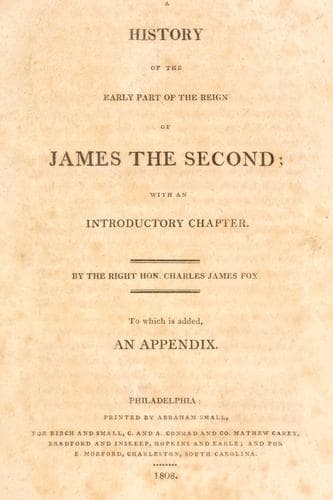
A History of the Early Part of the Reign of James the SecondFox, Charles James
History
A History of the Early Part of the Reign of James the Second
Fox, Charles James
Great Britain -- History -- James II, 1685-1688
When the small remains of this ill-fated army got together, in the
morning, at Kilpatrick, a place far distant from their destination, its
number was reduced to less than five hundred. Argyle had lost all
authority; nor, indeed, had he retained any, does it appear that he could
now have used it to any salutary purpose. The same bias which had
influenced the two parties in the time of better hopes, and with regard
to their early operations, still prevailed now that they were driven to
their last extremity. Sir Patrick Hume and Sir John Cochrane would not
stay even to reason the matter with him whom, at the onset of their
expedition, they had engaged to obey, but crossed the Clyde, with such as
would follow them to the number of about two hundred, into Renfrewshire.
Argyle, thus deserted, and almost alone, still looked to his own country
as the sole remaining hope, and sent off Sir Duncan Campbell, with the
two Duncansons, father and son--persons, all three, by whom he seemed to
have been served with the most exemplary zeal and fidelity--to attempt
new levies there. Having done this, and settled such means of
correspondence as the state of affairs would permit, he repaired to the
house of an old servant, upon whose attachment he had relied for an
asylum, but was peremptorily denied entrance. Concealment in this part
of the country seemed now impracticable, and he was forced at last to
pass the Clyde, accompanied by the brave and faithful Fullarton. Upon
coming to a ford of the Inchanon they were stopped by some militia-men.
Fullarton used in vain all the best means which his presence of mind
suggested to him to save his general. He attempted one while by gentle,
and then by harsher language, to detain the commander of the party till
the earl, who was habited as a common countryman, and whom he passed for
his guide, should have made his escape. At last, when he saw them
determined to go after his pretended guide, he offered to surrender
himself without a blow, upon condition of their desisting from their
pursuit. This agreement was accepted, but not adhered to, and two
horsemen were detached to seize Argyle. The earl, who was also on
horseback, grappled with them till one of them and himself came to the
ground. He then presented his pocket pistols, on which the two retired,
but soon after five more came up, who fired without effect, and he
thought himself like to get rid of them, but they knocked him down with
their swords and seized him. When they knew whom they had taken they
seemed much troubled, but dared not let him go. Fullarton, perceiving
that the stipulation on which he had surrendered himself was violated,
and determined to defend himself to the last, or at least to wreak,
before he fell, his just vengeance upon his perfidious opponents, grasped
at the sword of one of them, but in vain; he was overpowered, and made
prisoner.
Public-domain text, read in full here on John Shaqi.
Reviews
Reviews
No reviews yet
Be the first to share your thoughts on this work.
Elsewhere in the archive
Join the Discussion
Join the discussion
Sign in to leave a comment or review.
Sign InorCreate an account