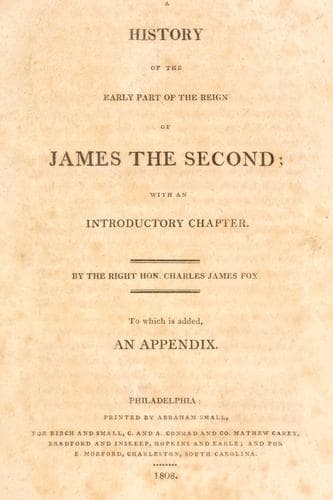
A History of the Early Part of the Reign of James the SecondFox, Charles James
History
A History of the Early Part of the Reign of James the Second
Fox, Charles James
Great Britain -- History -- James II, 1685-1688
Argyle was immediately carried to Renfrew, thence to Glasgow, and on the
20th of June was led in triumph into Edinburgh. The order of the council
was particular: that he should be led bareheaded in the midst of Graham's
guards, with their matches cocked, his hands tied behind his back, and
preceded by the common hangman, in which situation, that he might be more
exposed to the insults and taunts of the vulgar, it was directed that he
should be carried to the castle by a circuitous route. To the equanimity
with which he bore these indignities, as indeed to the manly spirit
exhibited by him throughout, in these last scenes of his life, ample
testimony is borne by all the historians who have treated of them, even
those who are the least partial to him. He had frequent opportunities of
conversing, and some of writing, during his imprisonment, and it is from
such parts of these conversations and writings as have been preserved to
us, that we can best form to ourselves a just notion of his deportment
during that trying period; at the same time a true representation of the
temper of his mind in such circumstances will serve, in no small degree,
to illustrate his general character and disposition.
We have already seen how he expresses himself with regard to the men who,
by taking him, became the immediate cause of his calamity. He seems to
feel a sort of gratitude to them for the sorrow he saw, or fancied he saw
in them, when they knew who he was, and immediately suggests an excuse
for them, by saying that they did not dare to follow the impulse of their
hearts. Speaking of the supineness of his countrymen, and of the little
assistance he had received from them, he declares with his accustomed
piety his resignation to the will of God, which was that Scotland should
not be delivered at this time, nor especially by his hand; and then
exclaims, with the regret of a patriot, but with no bitterness of
disappointment, "But alas! who is there to be delivered! There may,"
says he, "be hidden ones, but there appears no great party in the country
who desire to be relieved." Justice, in some degree, but still more that
warm affection for his own kindred and vassals, which seems to have
formed a marked feature in this nobleman's character, then induces him to
make an exception in favour of his poor friends in Argyleshire, in
treating for whom, though in what particular way does not appear, he was
employing, and with some hope of success, the few remaining hours of his
life. In recounting the failure of his expedition it is impossible for
him not to touch upon what he deemed the misconduct of his friends; and
this is the subject upon which of all others, his temper must have been
most irritable. A certain description of friends (the words describing
them are omitted) were all of them without exception, his greatest
enemies, both to betray and destroy him; and . . . and . . . (the names
Public-domain text, read in full here on John Shaqi.
Reviews
Reviews
No reviews yet
Be the first to share your thoughts on this work.
Elsewhere in the archive
Join the Discussion
Join the discussion
Sign in to leave a comment or review.
Sign InorCreate an account