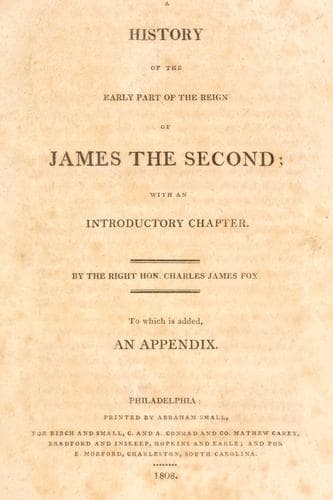
A History of the Early Part of the Reign of James the SecondFox, Charles James
History
A History of the Early Part of the Reign of James the Second
Fox, Charles James
Great Britain -- History -- James II, 1685-1688
Notwithstanding the ill success that had attended his enterprise, he
never expresses, or even hints, the smallest degree of contrition for
having undertaken it: on the contrary, when Mr. Charteris, an eminent
divine, is permitted to wait on him, his first caution to that minister
is, not to try to convince him of the unlawfulness of his attempt,
concerning which his opinion was settled, and his mind made up. Of some
parts of his past conduct he does indeed confess that he repents, but
these are the compliances of which he had been guilty in support of the
king, or his predecessors. Possibly in this he may allude to his having
in his youth borne arms against the covenant, but with more likelihood to
his concurrence, in the late reign, with some of the measures of
Lauderdale's administration, for whom it is certain that he entertained a
great regard, and to whom he conceived himself to be principally indebted
for his escape from his first sentence. Friendship and gratitude might
have carried him to lengths which patriotism and justice must condemn.
Religious concerns, in which he seems to have been very serious and
sincere, engaged much of his thoughts; but his religion was of that
genuine kind which, by representing the performance of our duties to our
neighbour as the most acceptable service to God, strengthens all the
charities of social life. While he anticipates, with a hope approaching
to certainty, a happy futurity, he does not forget those who have been
justly dear to him in this world. He writes, on the day of his
execution, to his wife, and to some other relations, for whom he seems to
have entertained a sort of parental tenderness, short, but the most
affectionate letters, wherein he gives them the greatest satisfaction
then in his power, by assuring them of his composure and tranquillity of
mind, and refers them for further consolation to those sources from which
he derived his own. In his letter to Mrs. Smith, written on the same
day, he says, "While anything was a burden to me, your concern was; which
is a cross greater than I can express" (alluding probably to the
pecuniary loss she had incurred); "but I have, I thank God, overcome
all." Her name, he adds, could not be concealed, and that he knows not
what may have been discovered from any paper which may have been taken;
otherwise he has named none to their disadvantage. He states that those
in whose hands he is, had at first used him hardly, but that God had
melted their hearts, and that he was now treated with civility. As an
instance of this, he mentions the liberty he had obtained of sending this
letter to her; a liberty which he takes as a kindness on their part, and
which he had sought that she might not think he had forgotten her.
Public-domain text, read in full here on John Shaqi.
Reviews
Reviews
No reviews yet
Be the first to share your thoughts on this work.
Elsewhere in the archive
Join the Discussion
Join the discussion
Sign in to leave a comment or review.
Sign InorCreate an account