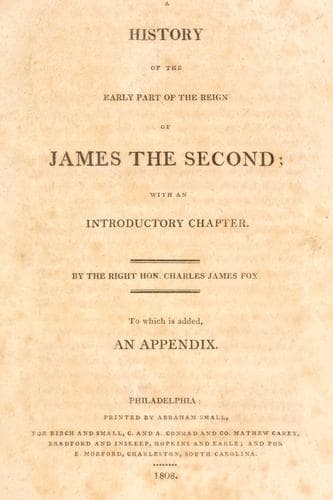
A History of the Early Part of the Reign of James the SecondFox, Charles James
History
A History of the Early Part of the Reign of James the Second
Fox, Charles James
Great Britain -- History -- James II, 1685-1688
again omitted) were the greatest cause of his rout, and his being taken,
though not designedly, he acknowledges, but by ignorance, cowardice, and
faction. This sentence had scarce escaped him when, notwithstanding the
qualifying words with which his candour had acquitted the last-mentioned
persons of intentional treachery, it appeared too harsh to his gentle
nature, and declaring himself displeased with the hard epithets he had
used, he desires they may be put out of any account that is to be given
of these transactions. The manner in which this request is worded shows
that the paper he was writing was intended for a letter, and as it is
supposed, to a Mrs. Smith, who seems to have assisted him with money; but
whether or not this lady was the rich widow of Amsterdam, before alluded
to, I have not been able to learn.
When he is told that he is to be put to the torture, he neither breaks
out into any high-sounding bravado, any premature vaunts of the
resolution with which he will endure it, nor, on the other hand, into
passionate exclamations on the cruelty of his enemies, or unmanly
lamentations of his fate. After stating that orders were arrived that he
must be tortured, unless he answers all questions upon oath, he simply
adds that he hopes God will support him; and then leaves off writing, not
from any want of spirits to proceed, but to enjoy the consolation which
was yet left him, in the society of his wife, the countess being just
then admitted.
Of his interview with Queensbury, who examined him in private, little is
known, except that he denied his design having been concerted with any
persons in Scotland; that he gave no information with respect to his
associates in England; and that he boldly and frankly averred his hopes
to have been founded on the cruelty of the administration, and such a
disposition in the people to revolt as he conceived to be the natural
consequence of oppression. He owned, at the same time, that he had
trusted too much to this principle. The precise date of this
conversation, whether it took place before the threat of the torture,
whilst that threat was impending, or when there was no longer any
intention of putting it into execution, I have not been able to
ascertain; but the probability seems to be that it was during the first
or second of these periods.
Public-domain text, read in full here on John Shaqi.
Reviews
Reviews
No reviews yet
Be the first to share your thoughts on this work.
Elsewhere in the archive
Join the Discussion
Join the discussion
Sign in to leave a comment or review.
Sign InorCreate an account