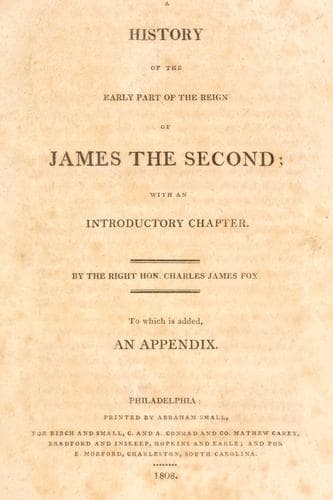
A History of the Early Part of the Reign of James the SecondFox, Charles James
History
A History of the Early Part of the Reign of James the Second
Fox, Charles James
Great Britain -- History -- James II, 1685-1688
Soon after his short repose Argyle was brought, according to order, to
the Laigh Council-house, from which place is dated the letter to his
wife, and thence to the place of execution. On the scaffold he had some
discourse, as well with Mr. Annand, a minister appointed by government to
attend him, as with Mr. Charteris. He desired both of them to pray for
him, and prayed himself with much fervency and devotion. The speech
which he made to the people was such as might be expected from the
passages already related. The same mixture of firmness and mildness is
conspicuous in every part of it. "We ought not," says he, "to despise
our afflictions, nor to faint under them. We must not suffer ourselves
to be exasperated against the instruments of our troubles, nor by
fraudulent, nor pusillanimous compliances, bring guilt upon ourselves;
faint hearts are ordinarily false hearts, choosing sin rather than
suffering." He offers his prayers to God for the three kingdoms of
England, Scotland, and Ireland, and that an end may be put to their
present trials. Having then asked pardon for his own failings, both of
God and man, he would have concluded; but being reminded that he had said
nothing of the royal family, he adds that he refers, in this matter, to
what he had said at his trial concerning the test; that he prayed there
never might be wanting one of the royal family to support the Protestant
religion; and if any of them had swerved from the true faith, he prayed
God to turn their hearts, but, at any rate, to save His people from their
machinations. When he had ended, he turned to the south side of the
scaffold, and said, "Gentlemen, I pray you do not misconstruct my
behaviour this day; I freely forgive all men their wrongs and injuries
done against me, as I desire to be forgiven of God." Mr. Annand repeated
these words louder to the people. The earl then went to the north side
of the scaffold, and used the same or the like expressions. Mr. Annand
repeated them again, and said, "This nobleman dies a Protestant." The
earl stepped forward again, and said, "I die not only a Protestant, but
with a heart-hatred of popery, prelacy, and all superstition whatsoever."
It would perhaps have been better if these last expressions had never
been uttered, as there appears certainly something of violence in them
unsuitable to the general tenor of his language; but it must be
remembered, first, that the opinion that the pope is _Antichrist_ was at
that time general among almost all the zealous Protestants in these
kingdoms; secondly, that Annand being employed by government, and
probably an Episcopalian, the earl might apprehend that the declaration
of such a minister might not convey the precise idea which he, Argyle,
affixed to the word Protestant.
Public-domain text, read in full here on John Shaqi.
Reviews
Reviews
No reviews yet
Be the first to share your thoughts on this work.
Elsewhere in the archive
Join the Discussion
Join the discussion
Sign in to leave a comment or review.
Sign InorCreate an account