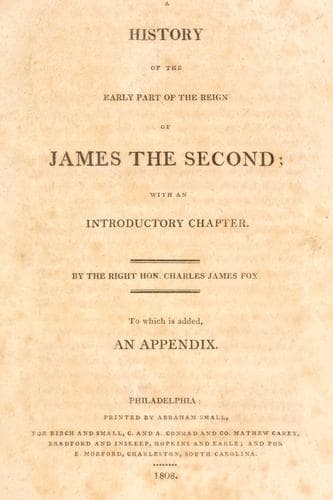
A History of the Early Part of the Reign of James the SecondFox, Charles James
History
A History of the Early Part of the Reign of James the Second
Fox, Charles James
Great Britain -- History -- James II, 1685-1688
He then embraced his friends, gave some tokens of remembrance to his son-
in-law, Lord Maitland, for his daughter and grandchildren, stripped
himself of part of his apparel, of which he likewise made presents, and
laid his head upon the block. Having uttered a short prayer, he gave the
signal to the executioner, which was instantly obeyed, and his head
severed from his body. Such were the last hours, and such the final
close, of this great man's life. May the like happy serenity in such
dreadful circumstances, and a death equally glorious, be the lot of all
whom tyranny, of whatever denomination or description, shall in any age,
or in any country, call to expiate their virtues on the scaffold!
Of the followers of Argyle, in the disastrous expedition above recounted,
the fortunes were various. Among those who either surrendered or were
taken, some suffered the same fate with their commander, others were
pardoned; while, on the other hand, of those who escaped to foreign
parts, many after a short exile returned triumphantly to their country at
the period of the revolution, and under a system congenial to their
principles, some even attained the highest honours of the State. It is
to be recollected that when, after the disastrous night-march from
Killerne, a separation took place at Kilpatrick between Argyle and his
confederates, Sir John Cochrane, Sir Patrick Hume, and others, crossed
the Clyde into Renfrewshire, with about, it is supposed, two hundred men.
Upon their landing they met with some opposition from a troop of militia
horse, which was, however, feeble and ineffectual; but fresh parties of
militia as well as regular troops drawing together, a sort of scuffle
ensued, near a place called Muirdyke; an offer of quarter was made by the
king's troops, but (probably on account of the conditions annexed to it)
was refused; and Cochrane and the rest, now reduced to the number of
seventy took shelter in a fold-dyke, where they were able to resist and
repel, though not without loss on each side, the attack of the enemy.
Their situation was nevertheless still desperate, and in the night they
determined to make their escape. The king's troops having retired, this
was effected without difficulty; and this remnant of an army being
dispersed by common consent, every man sought his own safety in the best
manner he could. Sir John Cochrane took refuge in the house of an uncle,
by whom, or by whose wife, it is said, he was betrayed. He was, however,
pardoned; and from this circumstance, coupled with the constant and
seemingly peevish opposition which he gave to almost all Argyle's plans,
a suspicion has arisen that he had been treacherous throughout. But the
account given of his pardon by Burnet, who says his father, Lord
Dundonald, who was an opulent nobleman, purchased it with a considerable
sum of money, is more credible, as well as more candid; and it must be
remembered that in Sir John's disputes with his general, he was almost
Public-domain text, read in full here on John Shaqi.
Reviews
Reviews
No reviews yet
Be the first to share your thoughts on this work.
Elsewhere in the archive
Join the Discussion
Join the discussion
Sign in to leave a comment or review.
Sign InorCreate an account