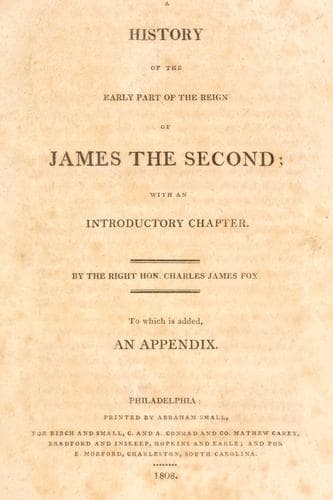
A History of the Early Part of the Reign of James the SecondFox, Charles James
History
A History of the Early Part of the Reign of James the Second
Fox, Charles James
Great Britain -- History -- James II, 1685-1688
Ayloff, having in vain attempted to kill himself, was, like Cochrane,
sent to London to be examined. His relationship to the king's first wife
might perhaps be one inducement to this measure, or it might be thought
more expedient that he should be executed for the Rye House Plot, the
credit of which it was a favourite object of the court to uphold, than
for his recent acts of rebellion in Scotland. Upon his examination he
refused to give any information, and suffered death upon a sentence of
outlawry, which had passed in the former reign. It is recorded that
James interrogated him personally, and finding him sullen, and unwilling
to speak, said: "Mr. Ayloff, you know it is in my power to pardon you,
therefore say that which may deserve it:" to which Ayloff replied:
"Though it is in your power, it is not in your nature to pardon." This,
however, is one of those anecdotes which are believed rather on account
of the air of nature that belongs to them, than upon any very good
traditional authority, and which ought, therefore when any very material
inference with respect either to fact or character, is to be drawn from
them, to be received with great caution.
Rumbold, covered with wounds, and defending himself with uncommon
exertions of strength and courage, was at last taken. However desirable
it might have been thought to execute in England a man so deeply
implicated in the Rye House Plot, the state of Rumbold's health made such
a project impracticable. Had it been attempted he would probably, by a
natural death, have disappointed the views of a government who were eager
to see brought to the block a man whom they thought, or pretended to
think, guilty of having projected the assassination of the late and
present king. Weakened as he was in body, his mind was firm, his
constancy unshaken; and notwithstanding some endeavours that were made by
drums and other instruments, to drown his voice when he was addressing
the people from the scaffold, enough has been preserved of what he then
uttered to satisfy us that his personal courage, the praise of which has
not been denied him, was not of the vulgar or constitutional kind, but
was accompanied with a proportionable vigour of mind. Upon hearing his
sentence, whether in imitation of Montrose, or from that congeniality of
character which causes men in similar circumstances to conceive similar
sentiments, he expressed the same wish which that gallant nobleman had
done; he wished he had a limb for every town in Christendom. With
respect to the intended assassination imputed to him, he protested his
innocence, and desired to be believed upon the faith of a dying man;
adding, in terms as natural as they are forcibly descriptive of a
conscious dignity of character, that he was too well known for any to
have had the imprudence to make such a proposition to him. He concluded
with plain, and apparently sincere, declarations of his undiminished
Public-domain text, read in full here on John Shaqi.
Reviews
Reviews
No reviews yet
Be the first to share your thoughts on this work.
Elsewhere in the archive
Join the Discussion
Join the discussion
Sign in to leave a comment or review.
Sign InorCreate an account