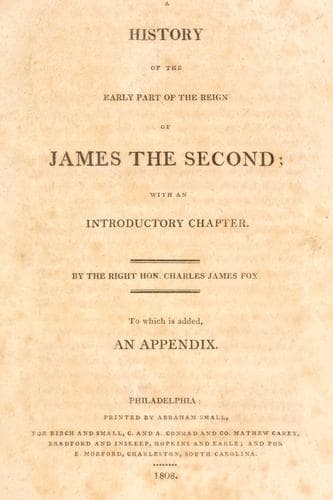
A History of the Early Part of the Reign of James the SecondFox, Charles James
History
A History of the Early Part of the Reign of James the Second
Fox, Charles James
Great Britain -- History -- James II, 1685-1688
always acting in conjunction with Sir Patrick Hume, who is proved, by the
subsequent events, and indeed by the whole tenor of his life and conduct,
to have been uniformly sincere and zealous in the cause of his country.
Cochrane was sent to England, where he had an interview with the king,
and gave such answers to the questions put to him as were deemed
satisfactory by his majesty; and the information thus obtained whatever
might be the real and secret causes, furnished a plausible pretence at
least for the exercise of royal mercy. Sir Patrick Hume, after having
concealed himself some time in the house, and under the protection of
Lady Eleanor Dunbar, sister to the Earl of Eglington, found means to
escape to Holland, whence he returned in better times, and was created
first Lord Hume of Polwarth, and afterwards Earl of Marchmont. Fullarton,
and Campbell of Auchinbreak, appear to have escaped, but by what means is
not known. Two sons of Argyle, John and Charles, and Archibald Campbell,
his nephew, were sentenced to death and forfeiture, but the capital part
of the sentence was remitted. Thomas Archer, a clergyman, who had been
wounded at Muirdyke, was executed, notwithstanding many applications in
his favour, among which was one from Lord Drumlanrig, Queensbury's eldest
son. Woodrow, who was himself a Presbyterian minister, and though a most
valuable and correct historian, was not without a tincture of the
prejudices belonging to his order, attributes the unrelenting spirit of
the government in this instance to their malice against the clergy of his
sect. Some of the holy ministry, he observes, as Guthrie at the
restoration, Kidd and Mackail after the insurrections at Pentland and
Bothwell Bridge, and now Archer, were upon every occasion to be
sacrificed to the fury of the persecutors. But to him who is well
acquainted with the history of this period, the habitual cruelty of the
government will fully account for any particular act of severity; and it
is only in cases of lenity, such as that of Cochrane, for instance, that
he will look for some hidden or special motive.
Public-domain text, read in full here on John Shaqi.
Reviews
Reviews
No reviews yet
Be the first to share your thoughts on this work.
Elsewhere in the archive
Join the Discussion
Join the discussion
Sign in to leave a comment or review.
Sign InorCreate an account