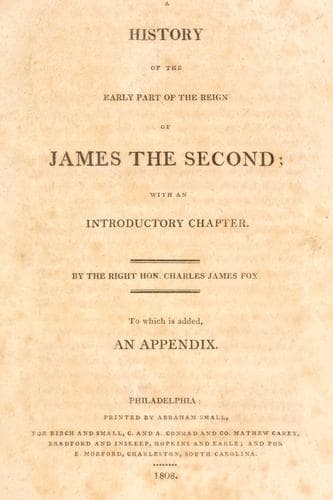
A History of the Early Part of the Reign of James the SecondFox, Charles James
History
A History of the Early Part of the Reign of James the Second
Fox, Charles James
Great Britain -- History -- James II, 1685-1688
between it and the paper adduced; but thus it is that the character of a
brave and, as far as appears, a virtuous man, is most unjustly and
cruelly traduced. An incredible confusion of head, and an uncommon want
of reasoning powers, which distinguish the author to whom I refer, are, I
should charitably hope, the true sources of his misrepresentation; while
others may probably impute it to his desire of blackening, upon any
pretence, a person whose name is more or less connected with those of
Sidney and Russell. It ought not, perhaps, to pass without observation,
that this attack upon Rumbold is introduced only in an oblique manner:
the rigour of government destroyed, says the historian, the morals it
intended to correct, and made the unhappy sufferer add to his former
crimes the atrocity of declaring a falsehood in his last moments. Now,
what particular instances of rigour are here alluded to, it is difficult
to guess: for surely the execution of a man whom he sets down as guilty
of a design to murder the two royal brothers, could not, even in the
judgment of persons much less accustomed than Sir John to palliate the
crimes of princes, be looked upon as an act of blameable severity; but it
was thought, perhaps, that for the purpose of conveying a calumny upon
the persons concerned, or accused of being concerned, in the Rye House
Plot, an affected censure upon the government would be the fittest
vehicle.
The fact itself, that Rumbold did, in his last hours, solemnly deny the
having been concerned in any project for assassinating the king or duke,
has not, I believe, been questioned. It is not invalidated by the
silence of some historians: it is confirmed by the misrepresentation of
others. The first question that naturally presents itself must be, was
this declaration true? The asseverations of dying men have always had,
and will always have, great influence upon the minds of those who do not
push their ill opinion of mankind to the most outrageous and
unwarrantable length; but though the weight of such asseverations be in
all cases great, it will not be in all equal. It is material therefore
to consider, first, what are the circumstances which may tend in
particular cases to diminish their credit; and next, how far such
circumstances appear to have existed in the case before us. The case
where this species of evidence would be the least convincing, would be
where hope of pardon is entertained; for then the man is not a dying man
in the sense of the proposition, for he has not that certainty that his
falsehood will not avail him, which is the principal foundation of the
credit due to his assertions. For the same reason, though in a less
degree, he who hopes for favour to his children, or to other surviving
connections, is to be listened to with some caution; for the existence of
one virtue does not necessarily prove that of another, and he who loves
his children and friends may yet be profligate and unprincipled; or,
Public-domain text, read in full here on John Shaqi.
Reviews
Reviews
No reviews yet
Be the first to share your thoughts on this work.
Elsewhere in the archive
Join the Discussion
Join the discussion
Sign in to leave a comment or review.
Sign InorCreate an account