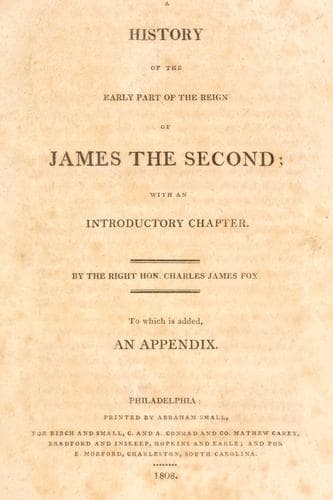
A History of the Early Part of the Reign of James the SecondFox, Charles James
History
A History of the Early Part of the Reign of James the Second
Fox, Charles James
Great Britain -- History -- James II, 1685-1688
deceiving himself, may think that while his ends are laudable, he ought
not to hesitate concerning the means. Besides these more obvious
temptations to prevarication, there is another which, though it may lie
somewhat deeper, yet experience teaches us to be rooted in human nature:
I mean that sort of obstinacy, or false shame, which makes men so
unwilling to retract what they have once advanced, whether in matter of
opinion or of fact. The general character of the man is also in this, as
in all other human testimony, a circumstance of the greatest moment.
Where none of the above-mentioned objections occur, and where therefore
the weight of evidence in question is confessedly considerable, yet is it
still liable to be balanced or outweighed by evidence in the opposite
scale.
Let Rumbold's declaration, then, be examined upon these principles, and
we shall find that it has every character of truth, without a single
circumstance to discredit it. He was so far from entertaining any hope
of pardon, that he did not seem even to wish it; and indeed if he had had
any such chimerical object in view, he must have known that to have
supplied the government with a proof of the Rye House assassination plot,
would be a more likely road at least, than a steady denial, to obtain it.
He left none behind him for whom to entreat favour, or whose welfare or
honour was at all affected by any confession or declaration he might
make. If, in a prospective view, he was without temptation, so neither,
if he looked back, was he fettered by any former declaration; so that he
could not be influenced by that erroneous notion of consistency to which
it may be feared that truth, even in the most awful moments, has in some
cases been sacrificed. His timely escape in 1683 had saved him from the
necessity of making any protestation upon the subject of his innocence at
that time; and the words of the letter to Walcot are so far from
containing such a protestation, that they are quoted (very absurdly, it
is true) by Sir John Dalrymple as an avowal of guilt. If his testimony
is free from these particular objections, much less is it impeached by
his general character, which was that of a bold and daring man, who was
very unlikely to feel shame in avowing what he had not been ashamed to
commit, and who seems to have taken a delight in speaking bold truths, or
at least what appeared to him to be such, without regarding the manner in
which his hearers were likely to receive them. With respect to the last
consideration, that of the opposite evidence, it all depends upon the
veracity of men who, according to their own account, betrayed their
comrades, and were actuated by the hope either of pardon or reward.
Public-domain text, read in full here on John Shaqi.
Reviews
Reviews
No reviews yet
Be the first to share your thoughts on this work.
Elsewhere in the archive
Join the Discussion
Join the discussion
Sign in to leave a comment or review.
Sign InorCreate an account