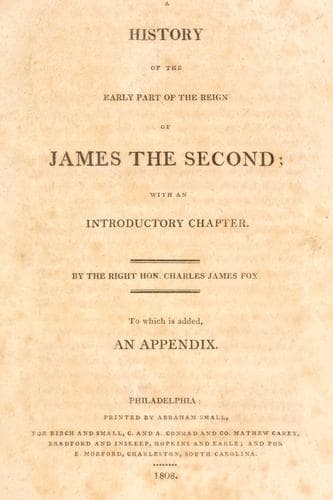
A History of the Early Part of the Reign of James the SecondFox, Charles James
History
A History of the Early Part of the Reign of James the Second
Fox, Charles James
Great Britain -- History -- James II, 1685-1688
Monmouth and Grey were now to be conveyed to London, for which purpose
they set out on the 11th, and arrived in the vicinity of the metropolis
on the 13th of July. In the meanwhile, the queen dowager, who seems to
have behaved with a uniformity of kindness towards her husband's son that
does her great honour, urgently pressed the king to admit his nephew to
an audience. Importuned, therefore, by entreaties, and instigated by the
curiosity which Monmouth's mysterious expressions, and Sheldon's story,
had excited, he consented, though with a fixed determination to show no
mercy. James was not of the number of those, in whom the want of an
extensive understanding is compensated by a delicacy of sentiment, or by
those right feelings, which are often found to be better guides for the
conduct than the most accurate reasoning. His nature did not revolt, his
blood did not run cold, at the thoughts of beholding the son of a brother
whom he had loved embracing his knees, petitioning, and petitioning in
vain, for life; of interchanging words and looks with a nephew, on whom
he was inexorably determined, within forty-eight short hours, to inflict
an ignominious death.
In Macpherson's extract from King James's "Memoirs," it is confessed that
the king ought not to have seen, if he was not disposed to pardon the
culprit; but whether the observation is made by the exiled prince
himself, or by him who gives the extract, is in this, as in many other
passages of those "Memoirs," difficult to determine. Surely if the king
had made this reflection before Monmouth's execution, it must have
occurred to that monarch, that if he had inadvertently done that which he
ought not to have done, without an intention to pardon, the only remedy
was to correct that part of his conduct which was still in his power, and
since he could not recall the interview, to grant the pardon.
Pursuant to this hard-hearted arrangement, Monmouth and Grey, on the very
day of their arrival, were brought to Whitehall, where they had severally
interviews with his majesty. James, in a letter to the Prince of Orange,
dated the following day, gives a short account of both these interviews.
Monmouth, he says, betrayed a weakness which did not become one who had
claimed the title of king; but made no discovery of consequence.
Public-domain text, read in full here on John Shaqi.
Reviews
Reviews
No reviews yet
Be the first to share your thoughts on this work.
Elsewhere in the archive
Join the Discussion
Join the discussion
Sign in to leave a comment or review.
Sign InorCreate an account