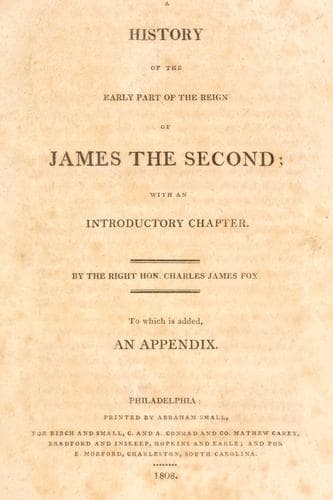
A History of the Early Part of the Reign of James the SecondFox, Charles James
History
A History of the Early Part of the Reign of James the Second
Fox, Charles James
Great Britain -- History -- James II, 1685-1688
Grey was more ingenuous (it is not certain in what sense his majesty uses
the term, since he does not refer to any discovery made by that lord),
and never once begged his life. Short as this account is, it seems the
only authentic one of those interviews. Bishop Kennet, who has been
followed by most of the modern historians, relates, that "This unhappy
captive, by the intercession of the queen dowager, was brought to the
king's presence, and fell presently at his feet, and confessed he
deserved to die; but conjured him, with tears in his eyes, not to use him
with the severity of justice, and to grant him a life, which he would be
ever ready to sacrifice for his service. He mentioned to him the example
of several great princes, who had yielded to the impressions of clemency
on the like occasions, and who had never afterwards repented of those
acts of generosity and mercy; concluding, in a most pathetical manner,
'Remember, sir, I am your brother's son, and if you take my life, it is
your own blood that you will shed.' The king asked him several
questions, and made him sign a declaration that his father told him he
was never married to his mother: and then said, he was sorry indeed for
his misfortunes; but his crime was of too great a consequence to be left
unpunished, and he must of necessity suffer for it. The queen is said to
have insulted him in a very arrogant and unmerciful manner. So that when
the duke saw there was nothing designed by this interview but to satisfy
the queen's revenge, he rose up from his majesty's feet with a new air of
bravery, and was carried back to the Tower."
The topics used by Monmouth are such as he might naturally have employed,
and the demeanour attributed to him, upon finding the king inexorable, is
consistent enough with general probability, and his particular character;
but that the king took care to extract from him a confession of Charles's
declaration with respect to his illegitimacy, before he announced his
final refusal of mercy, and that the queen was present for the purpose of
reviling and insulting him, are circumstances too atrocious to merit
belief, without some more certain evidence. It must be remarked also,
that Burnet, whose general prejudices would not lead him to doubt any
imputations against the queen, does not mention her majesty's being
present. Monmouth's offer of changing religion is mentioned by him, but
no authority quoted; and no hint of the kind appears either in James's
Letters, or in the extract from his "Memoirs."
Public-domain text, read in full here on John Shaqi.
Reviews
Reviews
No reviews yet
Be the first to share your thoughts on this work.
Elsewhere in the archive
Join the Discussion
Join the discussion
Sign in to leave a comment or review.
Sign InorCreate an account