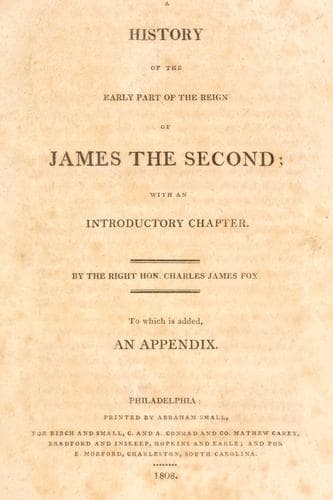
A History of the Early Part of the Reign of James the SecondFox, Charles James
History
A History of the Early Part of the Reign of James the Second
Fox, Charles James
Great Britain -- History -- James II, 1685-1688
"MONMOUTH."
There was nothing, they said, in that paper about resistance; nor, though
Monmouth, quite worn-out with their importunities, said to one of them,
in the most affecting manner, "I am to die--pray my lord--I refer to my
paper," would those men think it consistent with their duty to desist.
There were only a few words they desired on one point. The substance of
these applications on the one hand, and answers on the other, was
repeated over and over again, in a manner that could not be believed, if
the facts were not attested by the signatures of the persons principally
concerned. If the duke, in declaring his sorrow for what had passed,
used the word invasion, "Give it the true name," said they, "and call it
rebellion." "What name you please," replied the mild-tempered Monmouth.
He was sure he was going to everlasting happiness, and considered the
serenity of his mind in his present circumstances as a certain earnest of
the favour of his Creator. His repentance, he said, must be true, for he
had no fear of dying; he should die like a lamb. "Much may come from
natural courage," was the unfeeling and stupid reply of one of the
assistants. Monmouth, with that modesty inseparable from true bravery,
denied that he was in general less fearful than other men, maintaining
that his present courage was owing to his consciousness that God had
forgiven him his past transgressions, of all which generally he repented
with all his soul.
At last the reverend assistants consented to join with him in prayer, but
no sooner were they risen from their kneeling posture than they returned
to their charge. Not satisfied with what had passed, they exhorted him
to a true and thorough repentance. Would he not pray for the king, and
send a dutiful message to his majesty to recommend the duchess and his
children? "As you please," was the reply; "I pray for him and for all
men." He now spoke to the executioner, desiring that he might have no
cap over his eyes, and began undressing. One would have thought that in
this last sad ceremony, the poor prisoner might have been unmolested, and
that the divines would have been satisfied that prayer was the only part
of their function for which their duty now called upon them. They judged
differently, and one of them had the fortitude to request the duke, even
in this stage of the business, that he would address himself to the
soldiers then present, to tell them he stood a sad example of rebellion,
and entreat the people to be loyal and obedient to the king. "I have
said I will make no speeches," repeated Monmouth, in a tone more
peremptory than he had before been provoked to; "I will make no speeches.
I come to die." "My lord, ten words will be enough," said the
persevering divine; to which the duke made no answer, but turning to the
executioner, expressed a hope that he would do his work better now than
in the case of Lord Russell. He then felt the axe, which he apprehended
Public-domain text, read in full here on John Shaqi.
Reviews
Reviews
No reviews yet
Be the first to share your thoughts on this work.
Elsewhere in the archive
Join the Discussion
Join the discussion
Sign in to leave a comment or review.
Sign InorCreate an account