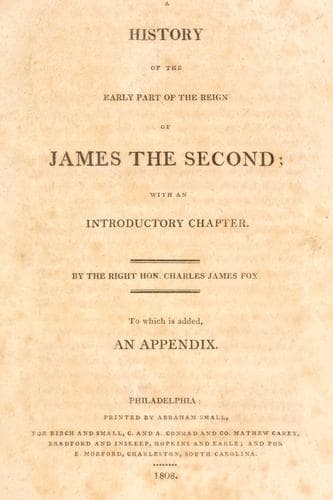
A History of the Early Part of the Reign of James the SecondFox, Charles James
History
A History of the Early Part of the Reign of James the Second
Fox, Charles James
Great Britain -- History -- James II, 1685-1688
was not sharp enough, but being assured that it was of proper sharpness
and weight, he laid down his head. In the meantime many fervent
ejaculations were used by the reverend assistants, who, it must be
observed, even in these moments of horror, showed themselves not
unmindful of the points upon which they had been disputing, praying God
to accept his imperfect and general repentance.
The executioner now struck the blow, but so feebly or unskilfully, that
Monmouth, being but slightly wounded, lifted up his head, and looked him
in the face as if to upbraid him, but said nothing. The two following
strokes were as ineffectual as the first, and the headsman, in a fit of
horror, declared he could not finish his work. The sheriffs threatened
him; he was forced again to make a further trial, and in two more strokes
separated the head from the body.
Thus fell, in the thirty-sixth year of his age, James, Duke of Monmouth,
a man against whom all that has been said by the most inveterate enemies
both to him and his party amounts to little more than this, that he had
not a mind equal to the situations in which his ambition, at different
times, engaged him to place himself. But to judge him with candour, we
must make great allowances, not only for the temptations into which he
was led by the splendid prosperity of the earlier parts of his life, but
also for the adverse prejudices with which he was regarded by almost all
the contemporary writers, from whom his actions and character are
described. The Tories, of course, are unfavourable to him; and even
among the Whigs, there seems, in many, a strong inclination to disparage
him; some to excuse themselves for not having joined him, others to make
a display of their exclusive attachment to their more successful leader,
King William. Burnet says of Monmouth, that he was gentle, brave, and
sincere: to these praises, from the united testimony of all who knew him,
we may add that of generosity; and surely those qualities go a great way
in making up the catalogue of all that is amiable and estimable in human
nature. One of the most conspicuous features in his character seems to
have been a remarkable, and, as some think, a culpable degree of
flexibility. That such a disposition is preferable to its opposite
extreme, will be admitted by all who think that modesty, even in excess,
is more nearly allied to wisdom than conceit and self-sufficiency. He
who has attentively considered the political, or, indeed, the general
concerns of life, may possibly go still further, and rank a willingness
to be convinced, or in some cases even without conviction, to concede our
own opinion to that of other men, among the principal ingredients in the
composition of practical wisdom. Monmouth had suffered this flexibility,
so laudable in many cases, to degenerate into a habit which made him
often follow the advice, or yield to the entreaties, of persons whose
characters by no means entitled them to such deference.
Public-domain text, read in full here on John Shaqi.
Reviews
Reviews
No reviews yet
Be the first to share your thoughts on this work.
Elsewhere in the archive
Join the Discussion
Join the discussion
Sign in to leave a comment or review.
Sign InorCreate an account