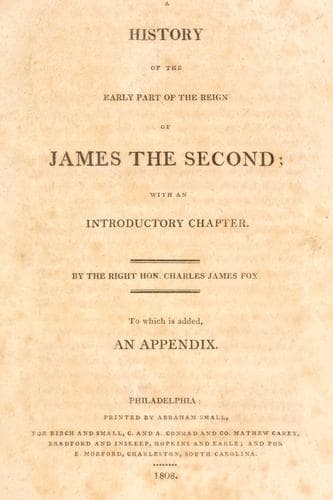
A History of the Early Part of the Reign of James the SecondFox, Charles James
History
A History of the Early Part of the Reign of James the Second
Fox, Charles James
Great Britain -- History -- James II, 1685-1688
While the Whigs considered all religious opinions with a view to
politics, the Tories, on the other hand, referred all political maxims to
religion. Thus the former, even in their hatred to popery, did not so
much regard the superstition, or imputed idolatry of that unpopular sect,
as its tendency to establish arbitrary power in the State, while the
latter revered absolute monarchy as a divine institution, and cherished
the doctrines of passive obedience and non-resistance as articles of
religious faith.
* * * * *
To mark the importance of the late events, his majesty caused two medals
to be struck; one of himself, with the usual inscription, and the motto,
_Aras et sceptra tuemur_; the other of Monmouth, without any inscription.
On the reverse of the former were represented the two headless trunks of
his lately vanquished enemies, with other circumstances in the same taste
and spirit, the motto, _Ambitio malesuada ruit_; on that of the latter
appeared a young man falling in the attempt to climb a rock with three
crowns on it, under which was the insulting motto, _Superi risere_.
* * * * *
With the lives of Monmouth and Argyle ended, or at least seemed to end,
all prospect of resistance to James's absolute power; and that class of
patriots who feel the pride of submission, and the dignity of obedience,
might be completely satisfied that the crown was in its full lustre.
James was sufficiently conscious of the increased strength of his
situation, and it is probable that the security he now felt in his power
inspired him with the design of taking more decided steps in favour of
the popish religion and its professors than his connection with the
Church of England party had before allowed him to entertain. That he
from this time attached less importance to the support and affection of
the Tories is evident from Lord Rochester's observations, communicated
afterwards to Burnet. This nobleman's abilities and experience in
business, his hereditary merit, as son of Lord Chancellor Clarendon, and
his uniform opposition to the Exclusion Bill, had raised him high in the
esteem of the Church party. This circumstance, perhaps, as much, or more
than the king's personal kindness to a brother-in-law, had contributed to
his advancement to the first office in the State. As long, therefore, as
James stood in need of the support of the party, as long as he meant to
make them the instruments of his power, and the channels of his favour,
Rochester was, in every respect, the fittest person in whom to confide;
and accordingly, as that nobleman related to Burnet, his majesty honoured
him with daily confidential communications upon all his most secret
schemes and projects. But upon the defeat of the rebellion, an immediate
change took place, and from the day of Monmouth's execution, the king
confined his conversations with the treasurer to the mere business of his
office.
Public-domain text, read in full here on John Shaqi.
Reviews
Reviews
No reviews yet
Be the first to share your thoughts on this work.
Elsewhere in the archive
Join the Discussion
Join the discussion
Sign in to leave a comment or review.
Sign InorCreate an account