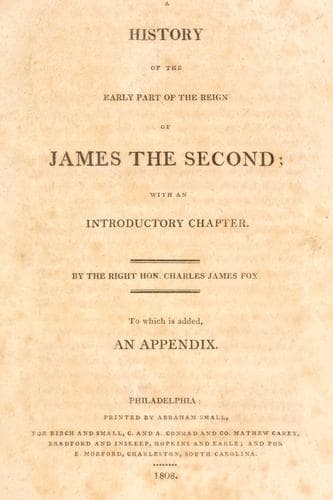
A History of the Early Part of the Reign of James the SecondFox, Charles James
History
A History of the Early Part of the Reign of James the Second
Fox, Charles James
Great Britain -- History -- James II, 1685-1688
The sagacity of
Shaftesbury, the honour of Russell, the genius of Sydney, might, in the
opinion of a modest man, be safe and eligible guides. The partiality of
friendship, and the conviction of his firm attachment, might be some
excuse for his listening so much to Grey; but he never could, at any
period of his life, have mistaken Ferguson for an honest man. There is
reason to believe that the advice of the two last-mentioned persons had
great weight in persuading him to the unjustifiable step of declaring
himself king. But far the most guilty act of this unfortunate man's life
was his lending his name to the declaration which was published at Lyme,
and in this instance Ferguson, who penned the paper, was both the adviser
and the instrument. To accuse the king of having burnt London, murdered
Essex in the Tower, and, finally, poisoned his brother, unsupported by
evidence to substantiate such dreadful charges, was calumny of the most
atrocious kind; but the guilt is still heightened, when we observe, that
from no conversation of Monmouth, nor, indeed, from any other
circumstance whatever, do we collect that he himself believed the horrid
accusations to be true. With regard to Essex's death in particular, the
only one of the three charges which was believed by any man of common
sense, the late king was as much implicated in the suspicion as James.
That the latter should have dared to be concerned in such an act, without
the privacy of his brother, was too absurd an imputation to be attempted,
even in the days of the popish plot. On the other hand, it was certainly
not the intention of the son to brand his father as an assassin. It is
too plain that, in the instance of this declaration, Monmouth, with a
facility highly criminal, consented to set his name to whatever Ferguson
recommended as advantageous to the cause. Among the many dreadful
circumstances attending civil wars, perhaps there are few more revolting
to a good mind than the wicked calumnies with which, in the heat of
contention, men, otherwise men of honour, have in all ages and countries
permitted themselves to load their adversaries. It is remarkable that
there is no trace of the divines who attended this unfortunate man having
exhorted him to a particular repentance of his manifesto, or having
called for a retraction or disavowal of the accusations contained in it.
They were so intent upon points more immediately connected with orthodoxy
of faith, that they omitted pressing their penitent to the only
declaration by which he could make any satisfactory atonement to those
whom he had injured.
FRAGMENTS.
_The following detached paragraphs were probably intended for the fourth
chapter_. _They are here printed in the incomplete and unfinished state
in which they were found_.
Public-domain text, read in full here on John Shaqi.
Reviews
Reviews
No reviews yet
Be the first to share your thoughts on this work.
Elsewhere in the archive
Join the Discussion
Join the discussion
Sign in to leave a comment or review.
Sign InorCreate an account