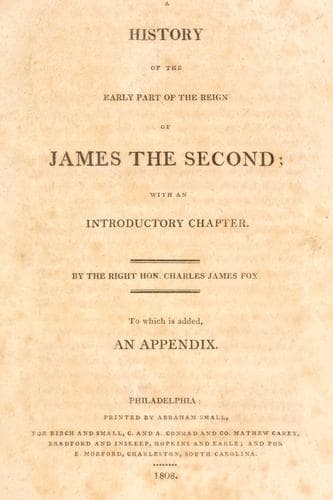
A History of the Early Part of the Reign of James the Second — John Shaqi
A History of the Early Part of the Reign of James the SecondFox, Charles James
History
A History of the Early Part of the Reign of James the Second
Fox, Charles James
Great Britain -- History -- James II, 1685-1688
and Dryden will not, by those who are conversant in the history and works
of that immortal writer, be suspected either of party prejudice in favour
of Shaftesbury and the Whigs, or of any view to prejudice the country
against the Duke of York's succession to the crown. The king repeatedly
declared his belief of it. These declarations, if sincere, would have
some weight; but if insincere, as may be reasonably suspected, they
afford a still stronger testimony to prove that such belief was not
exclusively a party opinion, since it cannot be supposed that even the
crooked politics of Charles could have led him to countenance fictions of
his enemies, which were not adopted by his own party. Wherefore, if this
question were to be decided upon the ground of authority, the reality of
the plot would be admitted; and it must be confessed, that, with regard
to facts remote, in respect either of time or place, wise men generally
diffide in their own judgment, and defer to that of those who have had a
nearer view of them. But there are cases where reason speaks so plainly
as to make all argument drawn from authority of no avail, and this is
surely one of them. Not to mention correspondence by post on the subject
of regicide, detailed commissions from the pope, silver bullets, &c. &c.,
and other circumstances equally ridiculous, we need only advert to the
part attributed to the Spanish government in this conspiracy, and to the
alleged intention of murdering the king, to satisfy ourselves that it was
a forgery.
Rapin, who argues the whole of this affair with a degree of weakness as
well as disingenuity very unusual to him, seems at last to offer us a
kind of compromise, and to be satisfied if we will admit that there was a
design or project to introduce popery and an arbitrary power, at the head
of which were the king and his brother. Of this I am as much convinced
as he can be; but how does this justify the prosecution and execution of
those who suffered, since few if any of them, were in a situation to be
trusted by the royal conspirators with their designs? When he says,
therefore, that that is precisely what was understood by the conspiracy,
he by no means justifies those who were the principal prosecutors of the
plot. The design to murder the king he calls the appendage of the plot:
a strange expression this, to describe the projected murder of a king;
though not more strange than the notion itself when applied to a plot,
the object of which was to render that very king absolute, and to
introduce the religion which he most favoured. But it is to be observed,
that though in considering the bill of exclusion, the militia bill, and
other legislative proceedings, the plot, as he defines it--that is to
say, the design of introducing popery and arbitrary power--was the
important point to be looked to; yet in courts of justice, and for juries
and judges, that which he calls the appendage was, generally speaking,
the sole consideration.
Public-domain text, read in full here on John Shaqi.
Reviews
Reviews
No reviews yet
Be the first to share your thoughts on this work.
Join the Discussion
Join the discussion
Sign in to leave a comment or review.
Sign InorCreate an account