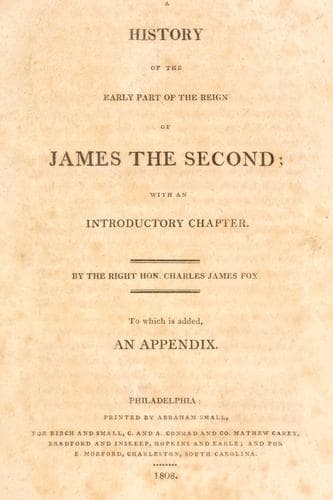
A History of the Early Part of the Reign of James the SecondFox, Charles James
History
A History of the Early Part of the Reign of James the Second
Fox, Charles James
Great Britain -- History -- James II, 1685-1688
It is said that the king, when at the summit of his power, was far from
happy; and a notion has been generally entertained that not long before
his death he had resolved upon the recall of Monmouth, and a
correspondent change of system. That some such change was apprehended
seems extremely probable, from the earnest desire which the court of
France, as well as the Duke of York's party in England, entertained, in
the last years of Charles's life, to remove the Marquis of Halifax, who
was supposed to have friendly dispositions to Monmouth. Among the
various objections to that nobleman's political principles, we find the
charge most relied upon, for the purpose of injuring him in the mind of
the king, was founded on the opinion he had delivered in council, in
favour of modelling the charters of the British colonies in North America
upon the principles of the rights and privileges of Englishmen. There
was no room to doubt (he was accused of saying) that the same laws under
which we live in England, should be established in a country composed of
Englishmen. He even dilated upon this, and omitted none of the reasons
by which it can be proved that an absolute government is neither so happy
nor so safe as that which is tempered by laws, and which limits the
authority of the prince. He exaggerated, it was said, the mischiefs of a
sovereign power, and declared plainly that he could not make up his mind
to live under a king who should have it in his power to take, when he
pleased, the money he might have in his pocket. All the other ministers
had combated, as might be expected, sentiments so extraordinary; and
without entering into the general question of the comparative value of
different forms of government, maintained that his majesty could and
ought to govern countries so distant in the manner that should appear to
him most suitable for preserving or augmenting the strength and riches of
the mother country. It had been, therefore, resolved that the government
and council of the provinces under the new charter should not be obliged
to call assemblies of the colonists for the purpose of imposing taxes, or
making other important regulations, but should do what they thought fit,
without rendering any account of their actions except to his Britannic
Majesty. The affair having been so decided with a concurrence only short
of unanimity, was no longer considered as a matter of importance, nor
would it be worth recording, if the Duke of York and the French court had
not fastened upon it, as affording the best evidence of the danger to be
apprehended from having a man of Halifax's principles in any situation of
trust or power. There is something curious in discovering that even at
this early period a question relative to North American liberty, and even
to North American taxation, was considered as the test of principles
friendly or adverse to arbitrary power at home. But the truth is, that
Public-domain text, read in full here on John Shaqi.
Reviews
Reviews
No reviews yet
Be the first to share your thoughts on this work.
Join the Discussion
Join the discussion
Sign in to leave a comment or review.
Sign InorCreate an account