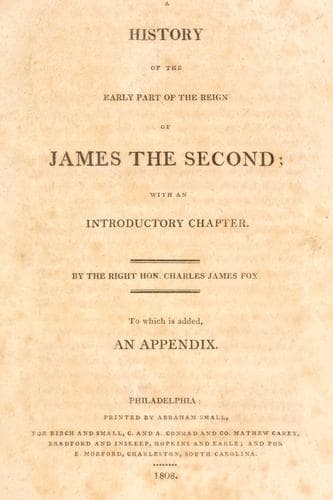
A History of the Early Part of the Reign of James the SecondFox, Charles James
History
A History of the Early Part of the Reign of James the Second
Fox, Charles James
Great Britain -- History -- James II, 1685-1688
Now it is proper in this place to inquire into the nature of the measures
thus extolled, as well for the purpose of elucidating the characters of
the king and his Scottish minsters, as for that of rendering more
intelligible the subsequent proceedings of the parliament, and the other
events which soon after took place in that kingdom. Some general notions
may be formed of that course of proceedings which, according to his
majesty's opinion, had been so laudably and resolutely pursued during the
late reign, from the circumstances alluded to in the preceding chapter,
when it is understood that the sentences of Argyle and Laurie of
Blackwood were not detached instances of oppression, but rather a sample
of the general system of administration. The covenant, which had been so
solemnly taken by the whole kingdom, and, among the rest, by the king
himself, had been declared to be unlawful, and a refusal to abjure it had
been made subject to the severest penalties. Episcopacy, which was
detested by a great majority of the nation, had been established, and all
public exercise of religion, in the forms to which the people were most
attached, had been prohibited. The attendance upon field conventicles
had been made highly penal, and the preaching at them capital, by which
means, according to the computation of a late writer, no less remarkable
for the accuracy of his facts than for the force and justness of his
reasonings, at least seventeen thousand persons in one district were
involved in criminality, and became the objects of persecution. After
this letters had been issued by government, forbidding the intercommuning
with persons who had neglected or refused to appear before the Privy
Council, when cited for the above crimes, a proceeding by which not only
all succour or assistance to such persons, but, according to the strict
sense of the word made use of, all intercourse with them, was rendered
criminal, and subjected him who disobeyed the prohibition to the same
penalties, whether capital or others, which were affixed to the alleged
crimes of the party with whom he had intercommuned.
Public-domain text, read in full here on John Shaqi.
Reviews
Reviews
No reviews yet
Be the first to share your thoughts on this work.
Elsewhere in the archive
Join the Discussion
Join the discussion
Sign in to leave a comment or review.
Sign InorCreate an account