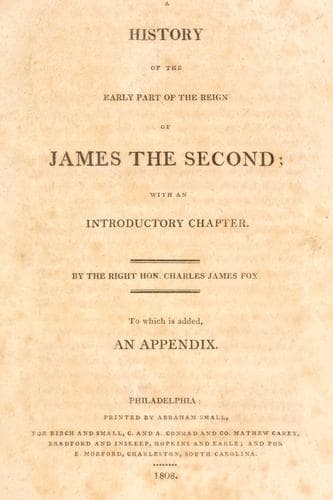
A History of the Early Part of the Reign of James the SecondFox, Charles James
History
A History of the Early Part of the Reign of James the Second
Fox, Charles James
Great Britain -- History -- James II, 1685-1688
These measures not proving effectual for the purpose for which they were
intended, or, as some say, the object of Charles II.'s government being
to provoke an insurrection, a demand was made upon the landholders in the
district supposed to be most disaffected of bonds, whereby they were to
become responsible for their wives, families, tenants, and servants, and
likewise for the wives, families, and servants of their tenants, and,
finally, for all persons living upon their estates, that they should not
withdraw from the Church, frequent or preach at conventicles, nor give
any succour, or have any intercourse with persons with whom it was
forbidden to intercommune; and the penalties attached to the breach of
this engagement, the keeping of which was obviously out of the power of
him who was required to make it, were to be the same as those, whether
capital or other, to which the several persons for whom he engaged might
be liable. The landholders, not being willing to subscribe to their own
destruction, refused to execute the bonds, and this was thought
sufficient grounds for considering the district to which they belonged as
in a state of rebellion. English and Irish armies were ordered to the
frontiers; a train of artillery and the militia were sent into the
district itself; and six thousand Highlanders, who were let loose upon
its inhabitants, to exercise every species of pillage and plunder were
connived at, or rather encouraged, in excesses of a still more atrocious
nature.
The bonds being still refused, the government had recourse to an
expedient of a most extraordinary nature, and issued what the Scotch
called a writ of Lawburrows against the whole district. This writ of
Lawburrows is somewhat analogous to what we call "swearing the peace"
against any one, and had hitherto been supposed, as the other is with us,
to be applicable to the disputes of private individuals, and to the
apprehensions which, in consequence of such disputes, they may mutually
entertain of each other. A government swearing the peace against its
subjects was a new spectacle; but if a private subject, under fear of
another, hath a right to such a security, how much more the government
itself? was thought an unanswerable argument. Such are the sophistries
which tyrants deem satisfactory. Thus are they willing even to descend
from their loftiness into the situation of subjects or private men, when
it is for the purpose of acquiring additional powers of persecution; and
thus truly formidable and terrific are they, when they pretend alarm and
fear. By these writs the persons against whom they were directed were
bound, as in case of the former bonds, to conditions which were not in
their power to fulfil, such as the preventing of conventicles and the
like, under such penalties as the Privy Council might inflict, and a
disobedience to them was followed by outlawry and confiscation.
Public-domain text, read in full here on John Shaqi.
Reviews
Reviews
No reviews yet
Be the first to share your thoughts on this work.
Elsewhere in the archive
Join the Discussion
Join the discussion
Sign in to leave a comment or review.
Sign InorCreate an account