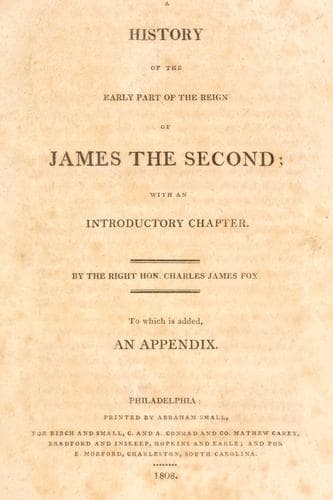
A History of the Early Part of the Reign of James the SecondFox, Charles James
History
A History of the Early Part of the Reign of James the Second
Fox, Charles James
Great Britain -- History -- James II, 1685-1688
The conduct of the Duke of Lauderdale, who was the chief actor in these
scenes of violence and iniquity, was completely approved and justified at
court; but in consequence probably of the state of politics in England at
a time when the Whigs were strongest in the House of Commons, some of
these grievances were in part redressed, and the Highlanders, and writs
of Lawburrows were recalled. But the country was still treated like a
conquered country. The Highlanders were replaced by an army of five
thousand regulars, and garrisons were placed in private houses. The
persecution of conventicles continued, and ample indemnity was granted
for every species of violence that might be exercised by those employed
to suppress them. In this state of things the assassination and murder
of Sharp, Archbishop of St. Andrews, by a troop of fanatics, who had been
driven to madness by the oppression of Carmichael, one of that prelate's
instruments, while it gave an additional spur to the vindictive temper of
the government, was considered by it as a justification for every mode
and degree of cruelty and persecution. The outrage committed by a few
individuals was imputed to the whole fanatic sect, as the government
termed them, or, in other words, to a description of people which
composed a great majority of the population in the Lowlands of Scotland;
and those who attended field or armed conventicles were ordered to be
indiscriminately massacred.
By such means an insurrection was at last produced, which, from the
weakness, or, as some suppose, from the wicked policy of an
administration eager for confiscations, and desirous of such a state of
the country as might, in some measure, justify their course of
government, made such a progress that the insurgents became masters of
Glasgow and the country adjacent. To quell these insurgents, who,
undisciplined as they were, had defeated Graham, afterwards Viscount
Dundee, the Duke of Monmouth was sent with an army from England; but,
lest the generous mildness of his nature should prevail, he had sealed
orders which he was not to open till in sight of the rebels, enjoining
him not to treat with them, but to fall upon them without any previous
negotiation. In pursuance of these orders the insurgents were attacked
at Bothwell Bridge, where, though they were entirely routed and
dispersed, yet because those who surrendered at discretion were not put
to death, and the army, by the strict enforcing of discipline, were
prevented from plunder and other outrages, it was represented by James,
and in some degree even by the king, that Monmouth had acted as if he had
meant rather to put himself at the head of the fanatics than to repel
them, and were inclined rather to court their friendship than to punish
their rebellion. All complaints against Lauderdale were dismissed, his
power confirmed, and an act of indemnity, which had been procured at
Monmouth's intercession, was so clogged with exceptions as to be of
Public-domain text, read in full here on John Shaqi.
Reviews
Reviews
No reviews yet
Be the first to share your thoughts on this work.
Elsewhere in the archive
Join the Discussion
Join the discussion
Sign in to leave a comment or review.
Sign InorCreate an account