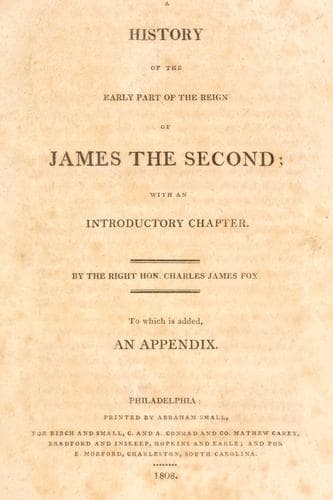
A History of the Early Part of the Reign of James the SecondFox, Charles James
History
A History of the Early Part of the Reign of James the Second
Fox, Charles James
Great Britain -- History -- James II, 1685-1688
The repetition of the words made use of in his first speech to the privy
council shows that, in the opinion of the court, at least, they had been
well chosen, and had answered their purpose; and even the haughty
language which was added, and was little less than a menace to parliament
if it should not comply with his wishes, was not, as it appears,
unpleasing to the party which at that time prevailed, since the revenue
enjoyed by his predecessor was unanimously, and almost immediately, voted
to him for life. It was not remarked, in public at least, that the
king's threat of governing without parliament was an unequivocal
manifestation of his contempt of the law of the country, so distinctly
established, though so ineffectually secured, by the statute of the
sixteenth of Charles II., for holding triennial parliaments. It is said
Lord-keeper Guildford had prepared a different speech for his majesty,
but that this was preferred, as being the king's own words; and, indeed,
that part of it in which he says that he must answer once for all that
the Commons giving such proportions as they might think convenient would
be a very improper way with him, bears, as well as some others, the most
evident marks of its royal origin. It is to be observed, however, that
in arguing for his demand, as he styles it, of revenue, he says, not that
the parliament ought not, but that he must not, suffer the well-being of
the government depending upon such revenue to be precarious; whence it is
evident that he intended to have it understood that if the parliament did
not grant, he purposed to levy a revenue without their consent. It is
impossible that any degree of party spirit should so have blinded men as
to prevent them from perceiving in this speech a determination on the
part of the king to conduct his government upon the principles of
absolute monarchy, and to those who were not so possessed with the love
of royalty, which creates a kind of passionate affection for whoever
happens to be the wearer of the crown, the vindictive manner in which he
speaks of Argyle's invasion might afford sufficient evidence of the
temper in which his power would be administered. In that part of his
speech he first betrays his personal feelings towards the unfortunate
nobleman, whom, in his brother's reign, he had so cruelly and
treacherously oppressed, by dwelling upon his being charged by Argyle
with tyranny and usurpation, and then declares that he will take the best
care, not according to the usual phrases to protect the loyal and well
disposed, and to restore tranquillity, but that the declaration of the
factious and rebellions may meet with the reward it deserves, thus
marking out revenge and punishment as the consequences of victory, upon
which he was most intent.
Public-domain text, read in full here on John Shaqi.
Reviews
Reviews
No reviews yet
Be the first to share your thoughts on this work.
Elsewhere in the archive
Join the Discussion
Join the discussion
Sign in to leave a comment or review.
Sign InorCreate an account