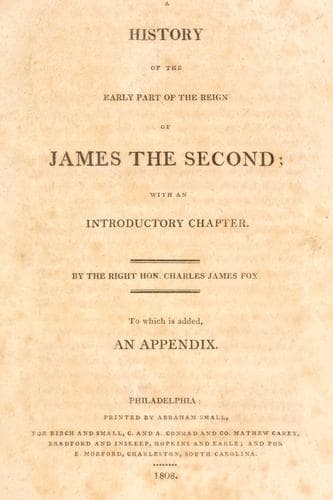
A History of the Early Part of the Reign of James the SecondFox, Charles James
History
A History of the Early Part of the Reign of James the Second
Fox, Charles James
Great Britain -- History -- James II, 1685-1688
It is impossible that in a House of Commons, however composed, there
should not have been many members who disapproved the principles of
government announced in the speech, and who were justly alarmed at the
temper in which it was conceived. But these, overpowered by numbers, and
perhaps afraid of the imputation of being concerned in plots and
insurrections (an imputation which, if they had shown any spirit of
liberty, would most infallibly have been thrown on them), declined
expressing their sentiments; and in the short session which followed
there was an almost uninterrupted unanimity in granting every demand, and
acquiescing in every wish of the government. The revenue was granted
without any notice being taken of the illegal manner in which the king
had levied it upon his own authority. Argyle was stigmatised as a
traitor; nor was any desire expressed to examine his declarations, one of
which seemed to be purposely withheld from parliament. Upon the
communication of the Duke of Monmouth's landing in the west that nobleman
was immediately attainted by bill. The king's assurance was recognised
as a sufficient security for the national religion; and the liberty of
the press was destroyed by the revival of the statute of the 13th and
14th of Charles II. This last circumstance, important as it is, does not
seem to have excited much attention at the time, which, considering the
general principles then in fashion, is not surprising. That it should
have been scarcely noticed by any historian is more wonderful. It is
true, however, that the terror inspired by the late prosecutions for
libels, and the violent conduct of the courts upon such occasions,
rendered a formal destruction of the liberty of the press a matter of
less importance. So little does the magistracy, when it is inclined to
act tyrannically, stand in need of tyrannical laws to effect its purpose.
The bare silence and acquiescence of the legislature is in such a case
fully sufficient to annihilate, practically speaking, every right and
liberty of the subject.
Public-domain text, read in full here on John Shaqi.
Reviews
Reviews
No reviews yet
Be the first to share your thoughts on this work.
Elsewhere in the archive
Join the Discussion
Join the discussion
Sign in to leave a comment or review.
Sign InorCreate an account